
By Sarah Caldwell
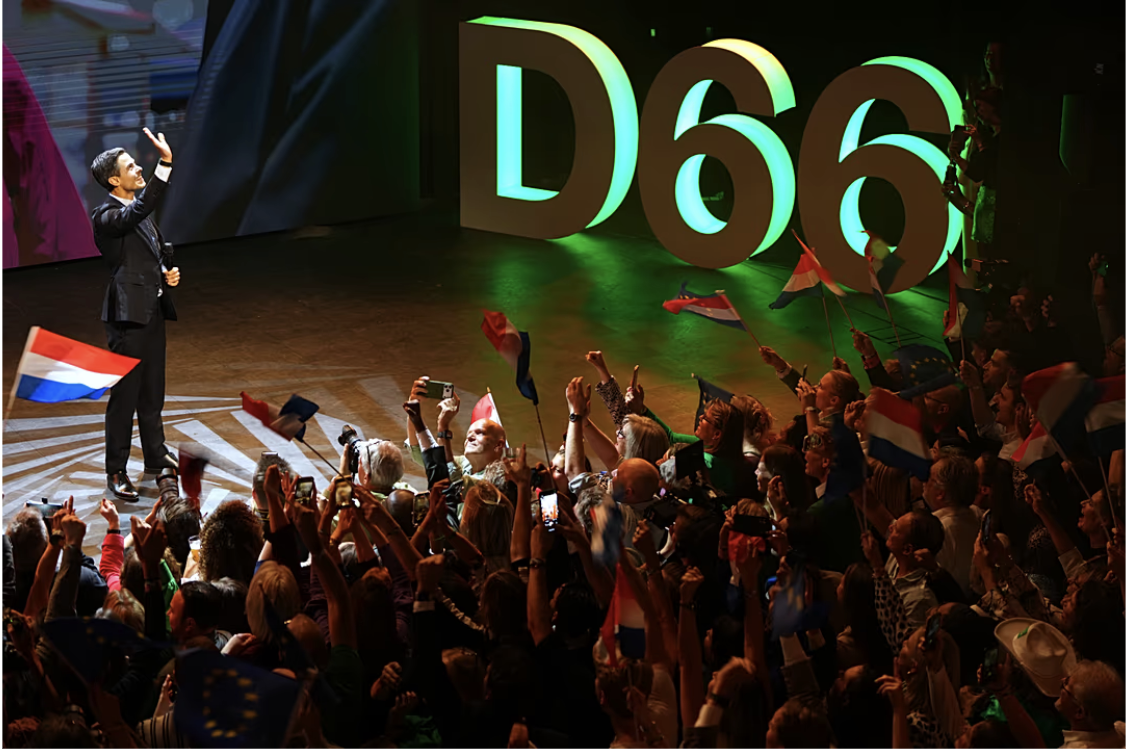
Netherlands: Rob Jetten is set to become the Netherlands’ youngest and first openly gay prime minister after his D66 Party narrowly beat Geert Wilder’s PVV Party this October. In a snap election where fifteen parties were vying for representation, the two top parties tied for seats, but Jetten’s centre-left party won by a narrow 29,000 votes.
The D66 party, which had a mere 9 seats less than two years ago, surged in the polls only in recent weeks following Jetten’s dazzling media campaign, which even included a hit appearance on a game show finale. He must now take on the difficult task of forming a coalition with at least three other parties to secure the 76 seats required to rule the country.
Jetten has thus far projected a message of unity, stating, “Voters have clearly indicated the need for cooperation. We want to find a majority that will eagerly work on issues such as the housing market, migration, climate and the economy.” It is unlikely that the process will move swiftly or smoothly, but Jetten and his supporters are confident that the party will accomplish more than the populist PVV Party managed before its coalition was swiftly disrupted after less than a year in power.
Tanzania: President Samia Suluhu Hassan has been re-elected after securing 97.6% of the vote in the country’s presidential election with an estimated 87% voter turnout. Hassan’s party, Chama Cha Mapinduzi (CCM) and its predecessor, Tanu, have not lost an election since Tanzania became independent from Great Britain in 1961.
Hassan called the elections “Free and Democratic” in her victory speech, yet international organisations, including the United Nations, are concerned about the validity of the election after Hassan’s two main challengers were barred from running and imprisoned. Additionally, in demonstrations leading up to the election, an estimated 500-3,000 protestors were killed in clashes with government security forces.
Hassan has backpedalled on many of the policies she championed when she became president in 2021, including ensuring transparency with the media and working with opposition parties. Now, as reports of government-sanctioned killings and mass arrests rise, the international community is fearing that the country, which was once praised for its stability and post-colonial unity, is slipping into a repressive, authoritarian regime.
Japan: Sanae Takaichi makes history as Japan’s first female prime minister, winning a wide majority in the Upper and Lower Houses in November’s Parliamentary elections. Takaichi, a staunch conservative and nationalist who draws close comparisons to Margaret Thatcher, was elected leader of the Liberal Democratic Party (LDP) in October and will now serve as Japan’s fourth prime minister in five years.
Takaichi’s win offers some optimism for Japan’s markets amidst the country’s rising debt and feeble growth. This outcome was very much hoped for by the LDP, which lost its majority in both houses for the first time since 1955. The choice of a conservative candidate like Takaichi comes in response to the success of Sanseito’s far-right, MAGA-style party in July – however, though Japan’s new ‘Iron Lady’ may be able to overrule its ‘mini-Trump’, Takaichi will face a difficult road ahead with mounting US tariffs and a China-Taiwan collision fast approaching.
Chile: The Latin American country hosted its first election with mandatory voting for all registered voters this month, with the entire Chamber of Deputies, almost half of the Senate and the Presidency all on the ballot. Leftwing blocs gained two seats to tie the Senate, but lost thirteen seats in the House, where right-wing parties can now build a majority coalition. None of the eight presidential candidates reached the 50% threshold to secure the presidency.
Janeatte Jara and Jose Antonio Kast, who received 26.7% and 24.1% of the vote, respectively, will face off in a runoff on 14 December. Jara, a member of the Communist Party and former labour minister, is running on a platform of reducing the cost of living and establishing a social safety net. Kast, embodying the messaging of far-right leaders like Milei and Trump, vowed to build a wall on the Bolivian border and immediately deport 337,000 undocumented immigrants.
Kast is widely projected to win the runoff, as he’s expected to attract the supporters of his three now-eliminated conservative rivals. If he becomes president, he will bring the far-right blueprint to Chile. Still, his party will not control both chambers of government, making it difficult for him to entirely reverse the progressive policies of the current left-leaning president, Gabriel Boric.
Guinea-Bissau: Results from the West African nation’s November presidential election have yet to be released after President Umaro Sissoco Embaló was captured in a coup by the country’s military. Senegal’s prime minister and Nigeria’s former president, as well as Embaló’s main opposition party, have called the coup a ‘sham’ and an attempt by Embaló’s administration to block the release of official election results after high voter turnout most likely led to a victory for the opposition party, PAIGC.
Embaló has been in power since 2020, but dissolved the country’s parliament in 2023 after what was also widely recognised as a ‘sham’ coup to keep opposition parties from gaining too much power. The country has not had a sitting legislature since then. Embaló’s presidential mandate expired in February, but his government did not announce elections until this month.
The country has experienced nine military coups since gaining independence from Portugal in 1974. The former president has since been released from military detention in Guinea-Bissau and has openly fled to Senegal. General Horta Inta-A has been named the head of a one-year transitional government, but it is unclear right now whether official election results will ever be released.
Ireland: A landslide victory led to the election of independent politician Catherine Connolly as the 10th President of the Republic of Ireland. Connolly secured a record 63% of the vote to defeat her opponent, Heather Humphrey, who represented the centre-right, ruling party, Fine Gael.
Connolly, who insisted her campaign was an anti-establish “movement” rather than a political endeavour, was backed by the progressive opposition party Sinn Féin as well as other, smaller, socialist parties. In her acceptance speech, she stated, first in Irish then in English, “I will be a voice for peace, a voice that builds on our policy of neutrality, a voice that articulates the existential threat posed by climate change, and a voice that recognises the tremendous work being done the length and breadth of the country.”
The views expressed in this article are the author’s own and may not reflect the opinions of The St Andrews Economist.
Image credit: EuroNews