
By Sydney Taylor
How corporate interests shape the boundaries of creative expression.
I paint, and I study how money moves. The two have a surprisingly complicated relationship. Artists like me are told expression is free; yet economists are told everything has a price. Both are right, which is precisely the problem.
Companies, meanwhile, like to present themselves as apolitical. Milton Friedman famously argued in 1970 that the social responsibility of business is to increase its profits. Per his view, staying out of politics is simply good business. Yet the art world, where expression and commerce collide, suggests neutrality is rather harder to achieve than it sounds. Every decision to fund, sell, restrict or conceal a work carries consequences beyond the balance sheet.
The question is not whether art and business should become political. It is whether they ever had the luxury of being otherwise.
The canvas has a business model
Start with the numbers. According to the Art Basel and UBS Global Art Market Report 2026, global art sales reached an estimated $59.6bn in 2025, an increase of 4% after two years of decline– the recovery was uneven, with growth concentrated among expensive works and established auction houses.
The market’s structure is unusual. Supply is often unique, prices depend as much on reputation as on intrinsic qualities, and a handful of institutions wield considerable influence. François Pinault has owned Christie’s since 1998, while Patrick Drahi acquired Sotheby’s in 2019 for $3.7bn. As Axios observed, Christie’s offers Mr Pinault more than financial returns: it provides access to the habits of the exceptionally wealthy and an avenue for building his own collection.
It is a peculiar industry in which those running the marketplace can also be among its most influential buyers.
Artists, by contrast, have historically enjoyed limited participation in the profits generated by subsequent sales. Britain’s Artist’s Resale Right, introduced in 2006, attempted to correct this imbalance by entitling eligible artists to royalties when their work is resold through professional art-market channels.
The legislation reveals something fundamental about the economics of art: the person who creates value is not necessarily the person best positioned to capture it.
Then comes the shredder
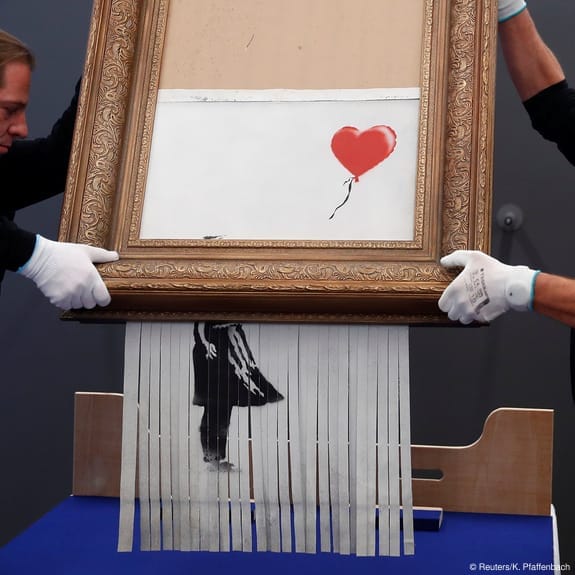
Few episodes illustrate the market’s contradictions better than Banksy’s spectacular act of self-destruction.
In October 2018, the piece Girl with Balloon sold at Sotheby’s for £1,042,000, and moments after the hammer fell, a shredder concealed within its frame began slicing the artwork into strips. What appeared to be a protest against the commodification of art became an entirely new commodity.
Three years later, the partially shredded work, renamed Love Is in the Bin, sold for £18.58m, nearly eighteen times its previous sale price. The hammer price was £16m, with the buyer’s premium accounting for the remainder.
The market was supposed to be Banksy’s audience, and instead, he made it part of the exhibition. An apparent rejection of commercial value had become the very reason for its multiplication.
There is an economic explanation: by transforming an ordinary auction into an unrepeatable cultural event, Banksy increased the work’s scarcity, publicity and historical significance. Its value no longer rested solely on the image, but on the story attached to it.
The legal consequences of artistic identity proved less profitable. In 2020, the European Union Intellectual Property Office invalidated Banksy’s trade mark for Flower Thrower after a challenge from a greeting-card company, finding that it had been registered in bad faith. His anonymity complicated the broader questions of authorship and intellectual-property protection, although the ruling was not simply a rejection of anonymous ownership.
As legal commentators noted, the case exposed tensions between artistic identity, commercial exploitation and trade-mark law.
Anonymity is excellent for mystique. It is considerably less convenient when intellectual property enters the picture.
When neutrality is made of plastic
My favorite example of failing corporate neutrality involves something considerably less glamorous than an auction house: Lego bricks.
In 2015, Chinese artist and dissident Ai Weiwei accused Lego of refusing to supply bricks in bulk for an exhibition at Melbourne’s National Gallery of Victoria. The company defended its position by citing a longstanding policy against involvement in projects with a political agenda.
The reasoning was understandable, as Lego wanted to avoid appearing to endorse a political message. But, refusing to supply the materials made the company part of the controversy it had hoped to avoid.
Following widespread criticism, Lego changed its policy, and from January 2016, it stopped asking customers placing large orders to disclose the intended purpose of their purchases.
This situation illustrates a distinction between neutrality of intention and neutrality of effect. Lego’s objective was to remain outside political debate, but its method, however, required judging which forms of expression were sufficiently political to exclude.
In trying to avoid taking sides, it had effectively appointed itself an arbiter of acceptable speech.
The revised policy offered a more defensible alternative: consistent commercial rules applied regardless of the customer’s message. That does not eliminate political interpretations, but it reduces the need for businesses to make subjective judgements about expression.
The sponsor’s halo
If Lego demonstrated the difficulty of withholding commercial support, museums reveal the complications of accepting it.
Cultural institutions depend on funding, and corporate sponsors gain something valuable in return: proximity to cultural prestige. For industries facing public criticism, association with respected institutions can improve their reputations.
Consider BP’s relationship with Tate. In 2016, the energy company ended its 26-year sponsorship, citing a challenging business environment rather than the protests surrounding its involvement.
Three years later, Tate announced that it would no longer accept donations from the Sackler
Trust, following growing scrutiny of the family’s connections to the opioid crisis. The Louvre similarly removed the Sackler name from its galleries after protests led by photographer Nan Goldin, although the museum attributed the change to the expiry of its naming agreement.
Critics call the reputational benefits of such arrangements artwashing: the use of cultural sponsorship to soften public perceptions of controversial businesses or benefactors.
Defenders make a reasonable counterargument. Private sponsorship supports exhibitions, conservation and public access that might otherwise lack funding. Rejecting every controversial donor could impose substantial costs on cultural institutions and their audiences.
Yet the economic calculation is changing. Sponsorship once offered companies an opportunity to borrow a museum’s reputation. Increasingly, museums must calculate the reputational cost of lending it.
Public pressure, in other words, can behave like a regulator even when no formal regulation changes.
Brands borrow brushstrokes
Luxury brands have long understood the commercial value of artistic credibility.
Louis Vuitton’s collaborations with Takashi Murakami and Yayoi Kusama, including the latter’s collections in 2012 and 2023, transformed artistic motifs into commercially successful fashion products. Its parent group, LVMH, also supports the Frank Gehry-designed Fondation Louis Vuitton, which opened in 2014.
The business logic is compelling. Art lends luxury goods qualities that conventional advertising struggles to manufacture: cultural legitimacy, originality and perceived scarcity. For artists, collaboration can provide financial rewards and access to audiences far beyond the gallery.
But the arrangement also raises questions of control. Licensing agreements determine how an artist’s work may be reproduced, distributed and commercialized. The parties may benefit together without possessing equal bargaining power.
The same tension appears in a more eccentric dispute over color.
In 2016, sculptor Anish Kapoor secured exclusive artistic use of Vantablack, an extraordinarily light-absorbing material developed by Surrey NanoSystems. This did not give him ownership of the color black, but it restricted other artists’ access to a particular technology.
Fellow artist Stuart Semple retaliated by selling his pinkest pink pigment to everyone except
Kapoor. The dispute attracted international attention, and tens of thousands of jars were sold.
It is both absurd and revealing. Materials become intellectual and commercial assets through contracts, while access to those assets can determine who gets to create what.
Expression may be free in principle. Its ingredients are not necessarily free in practice.
Every bubble needs a buyer
The rise and fall of art-related non-fungible tokens, or NFTs, offers another lesson in how markets assign value.
In March 2021, digital artist Beeple’s Everydays: The First 5000 Days sold at Christie’s for
$69.3m, including fees. Within weeks, the artist himself described the NFT market as a bubble.
The subsequent figures were striking. According to research published by DappRadar, trading volume in the art NFT market plummeted from approximately $2.9bn in 2021 to $197m in 2024, reaching just $23.8m in the first quarter of 2025.
For economists, the episode demonstrates the fragility of prices sustained by speculative demand. When buyers expect an asset’s value to rise, their willingness to purchase can itself push prices higher. But when confidence disappears, liquidity can evaporate with remarkable speed.
For artists, the lesson is more uncomfortable. A market that rewards hype does not necessarily reward artistic quality.
That does not mean digital art lacks enduring value. Supporters reasonably distinguish the medium from the speculative frenzy surrounding particular tokens. The collapse does, however, reveal how easily technological novelty and manufactured scarcity can be mistaken for durable economic worth.
Where art meets the law
The intersection of art and business becomes particularly consequential when ownership and regulation enter the picture.
High-value artworks are portable stores of wealth, sometimes held in specialized storage facilities known as freeports and their characteristics have raised concerns about transparency and financial crime.
The European Union’s Fifth Anti-Money Laundering Directive extended anti-money-laundering obligations to specified art-market participants and freeport operators. The legislation reflects a wider recognition that art transactions are not merely cultural exchanges; they can also function as significant financial transactions.
These rules introduce a familiar tension. Greater transparency can reduce opportunities for illicit finance, but it also increases compliance costs for legitimate businesses.
The central question is not whether art should be treated as a financial asset. It already is. The question is whether the institutions surrounding it should be subject to the scrutiny applied to other markets.
Even covering a painting is a statement
Perhaps the clearest illustration of the impossibility of neutrality occurred not in a gallery, but at the United Nations.
For decades, a tapestry reproduction of Picasso’s Guernica, one of the twentieth century’s most recognizable anti-war images, hung outside the Security Council chamber.
On 5 February 2003, before Colin Powell presented the American case for war in Iraq, the tapestry was concealed behind a blue curtain.
UN officials maintained that the curtain provided a more suitable backdrop for television cameras, as critics suspected that the painting’s depiction of the horrors of war was politically inconvenient. The precise motivation remains disputed. What matters is the contradiction: an effort presented as a practical decision about visual presentation became an international political controversy.
The tapestry was eventually returned to the Rockefeller family in 2021.
The problem with neutrality comes in one gesture: a painting does not become apolitical simply because someone hides it. Sometimes covering the artwork makes a louder statement than displaying it.
The price of staying silent
None of these cases establish that every company should adopt a political manifesto, or that every painting must communicate an ideological position. Businesses have legitimate reasons to avoid controversy, protect their commercial interests and maintain consistent relationships with customers.
But neutrality is not simply the absence of an expressed opinion.
The art market reveals how decisions about ownership, funding, access and presentation distribute power, influence reputations and shape public expression. Even apparently technical choices can acquire political significance when they determine who receives resources, whose work is displayed and which voices are heard.
The most credible form of corporate neutrality may therefore be procedural rather than absolute:
applying consistent rules, disclosing financial relationships and explaining decisions before controversy forces an explanation.
As someone interested in both artistic expression and the institutions that govern markets, I find the contradiction fascinating. Art is supposed to challenge how we see the world, and business is supposed to respond to the incentives operating within it. The two are constantly shaping each other.
The real choice is not between being political and remaining neutral; rather it is between recognizing the consequences of commercial decisions and pretending they do not exist.
After all, nobody hangs a neutral painting. Someone chooses the wall, someone pays for the frame, and someone decides whether it stays there.
The views expressed in this article are the author’s own and may not reflect the opinions of The St Andrews Economist.
Image Credit: DW.com