
By Leila Blackshaw-Brown
Reusing venues and purchasing renewable electricity can reduce the environmental impact of the Olympics. But neither solves the challenge of moving millions of people. At Paris 2024, travel accounted for 53% of the organisers’ reported carbon footprint, more than any other source. With LA28 less than two years away, transport will be an important test of its sustainability commitments.
Each Olympics offers an opportunity to address problems exposed by the last. Paris prioritised reusing venues, while Milan Cortina leaned on existing facilities and renewable electricity. LA plans to build on both, but its environmental record will also depend on how people reach the Games and move between venues. Comparing what these Games built, how they were powered and how people travelled shows where emissions can be cut, and where the key challenges are.
What did they build?
Most host cities need some new facilities, whether for accommodation or transportation. Paris used around 95% existing or temporary venues, which kept new construction down. Yet, construction still represented 29% of the reported footprint. This does not mean that reusing venues failed. It shows that even when most competition venues already exist, other construction can still add substantially to emissions.
Milan Cortina also relied heavily on existing facilities, but the reconstruction of the Cortina Sliding Centre complicated that approach. Organisers supported rebuilding the track, while the International Olympic Committee (IOC) wanted an existing venue abroad to cut costs. The dispute showed how the aim of reusing facilities can clash with a host’s desire to keep events at home.
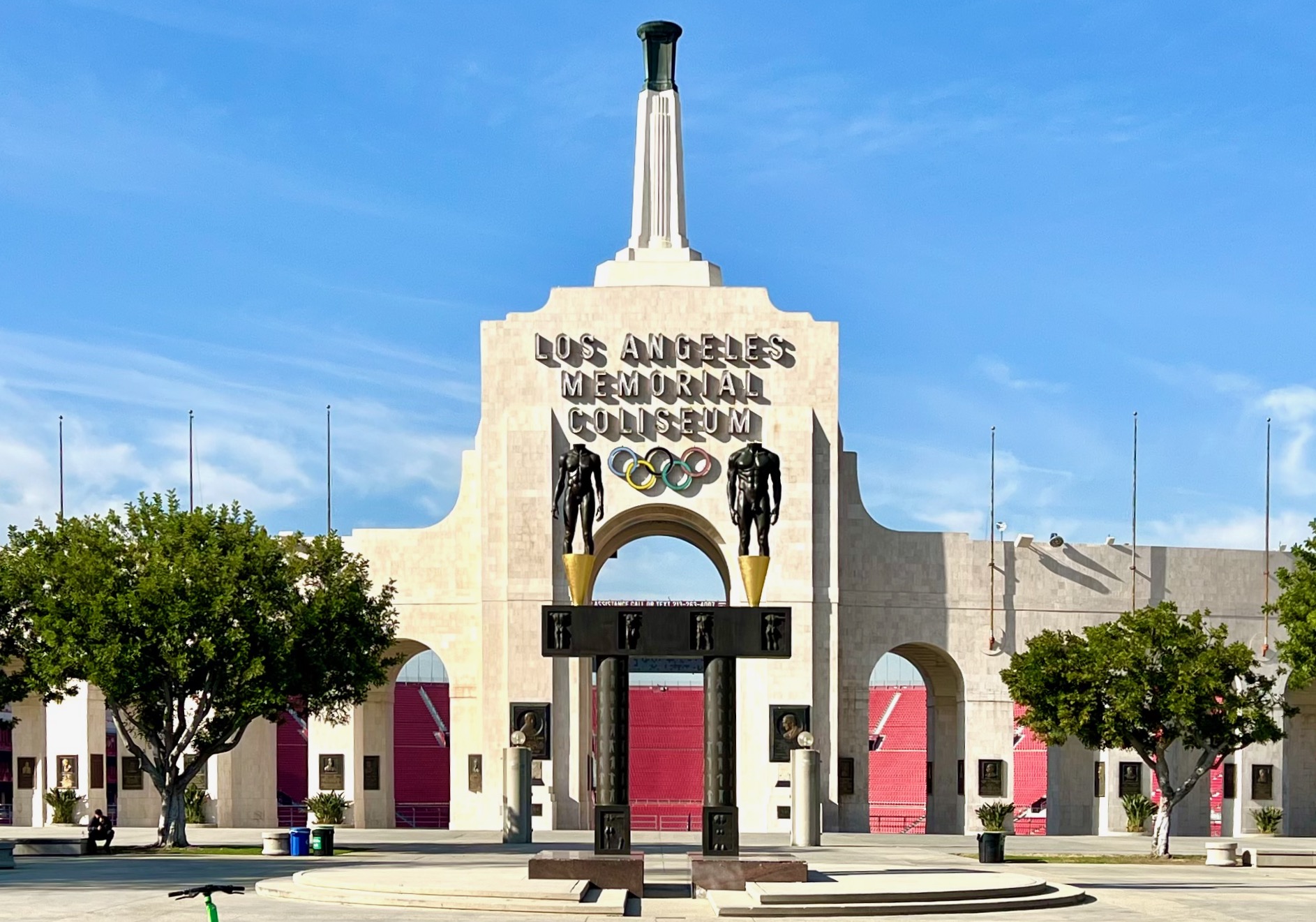
LA, on the other hand, will build no new permanent venues, relying instead on existing sites such as UCLA’s campus. It has also committed to a 10% cut in emissions from operations and construction relative to Paris 2024. Avoiding new permanent venues gives LA a strong start towards that commitment.
The scope of the target matters, however. Cutting operations and construction emissions is not the same as cutting the Games’ total footprint. LA’s existing facilities are an advantage, but meeting this target alone would say little about how well it has addressed spectator travel. Construction is only one part of the sustainability question.
How did they power it?
Everything at the Games needs power. The key sustainability question is where it comes from. Paris met more than 98% of its energy needs through grid electricity, with renewable sourcing arranged through a purchasing agreement with its supplier. The IOC’s post-Games assessment of Milan Cortina reported that nearly all competition venues ran on renewable electricity.
LA28 plans to purchase 100% renewable electricity for its venues. This addresses an important source of emissions, although the wording of the commitment needs to be understood carefully. It refers to electricity purchased for venues, not every form of energy used across the Games and the journeys to reach them.
There is also a difference between renewable electricity purchasing and physical supply. Guarantees of origin in Europe, and renewable energy certificates in the US, certify that a quantity of renewable electricity has been generated and supplied to the network. They do not mean that a venue receives electricity directly and exclusively from a renewable generator at every moment. These certificates provide evidence of renewable generation, but should not be confused with a dedicated clean electricity supply.
The question is therefore both how electricity is sourced and which activities the commitment covers. Cleaner venue electricity can cut emissions, but it cannot account for the full environmental impact of hosting an international event.
How did people get there?
One of the most significant challenges a host faces is transporting spectators, athletes and staff. Paris’s travel emissions exceeded the organisers’ original modelling, partly because of higher-than-expected ticket sales, at 12.1 million, and the number of spectators travelling from outside Europe. Its experience shows why progress in construction and energy must be considered alongside the journeys needed to attend the Games.
Milan Cortina illustrates another trade-off. Spreading events across northern Italy allowed organisers to use established sporting facilities. However, a geographically dispersed Games also makes transport planning more complicated. Reusing venues can avoid construction, while increasing the distances between events. Neither choice can be assessed fully without considering its effect on the wider footprint.
For LA, there are two separate transport questions: how people reach the host region and how they move around once they arrive. A better local bus network can reduce reliance on cars, but it cannot remove emissions from international flights. A successful local transport plan would therefore be an important improvement, while leaving another significant challenge unresolved.
LA28 has committed to a “transit-first” Games, and Metro is developing its Games Enhanced Transit System. Turning that commitment into a reliable service requires funding. LA has sought about $2 billion in federal support for Olympic transport. Congress approved $94.3 million in February 2026, following earlier funding, but a substantial gap remained.
The February allocation supports work including service planning, mobility hubs, station improvements and pedestrian access near venues. These measures matter because cleaner transport depends on more than the vehicles themselves: spectators also need services they can reach and use. The funding gap therefore bears directly on emissions, because it affects the delivery of alternatives to car travel.
There is progress that should not be overlooked. California’s Innovative Clean Transit rule requires 50% of new bus purchases by large transit agencies to be zero-emission from 2026, and 25% for smaller agencies. Metro is also expanding its electric fleet. In September its board approved 220 battery-electric buses. These developments could make Games transport cleaner and benefit everyday passengers afterwards.
However, purchasing buses is only part of providing a service. Vehicles need drivers, maintenance, charging facilities and reliable routes. Funding the equipment does not automatically fund its operation. From an emissions perspective, the important questions are whether cleaner buses are put into service and whether convenient public transport reduces car journeys. The number of vehicles purchased is evidence of progress, but it is not, by itself, a measure of the emissions saved.
Conclusion
LA has a clear opportunity to reduce Olympic emissions by reusing venues and purchasing renewable electricity. Paris and Milan Cortina show the value of these approaches, but also why individual commitments cannot stand in for an assessment of the whole Games.
Transport remains a major test. Funding will affect whether LA can deliver its local transport plans, while international travel presents a challenge beyond the reach of its bus network. The sustainability of LA28 will depend on how far its commitments reduce emissions across the Games, not just whether it meets targets in the areas where it already has an advantage.
The views expressed in this article are the author’s own and may not reflect the opinions of The St Andrews Economist.
Image Credit: Wikimedia Commons
