
By Helen Street
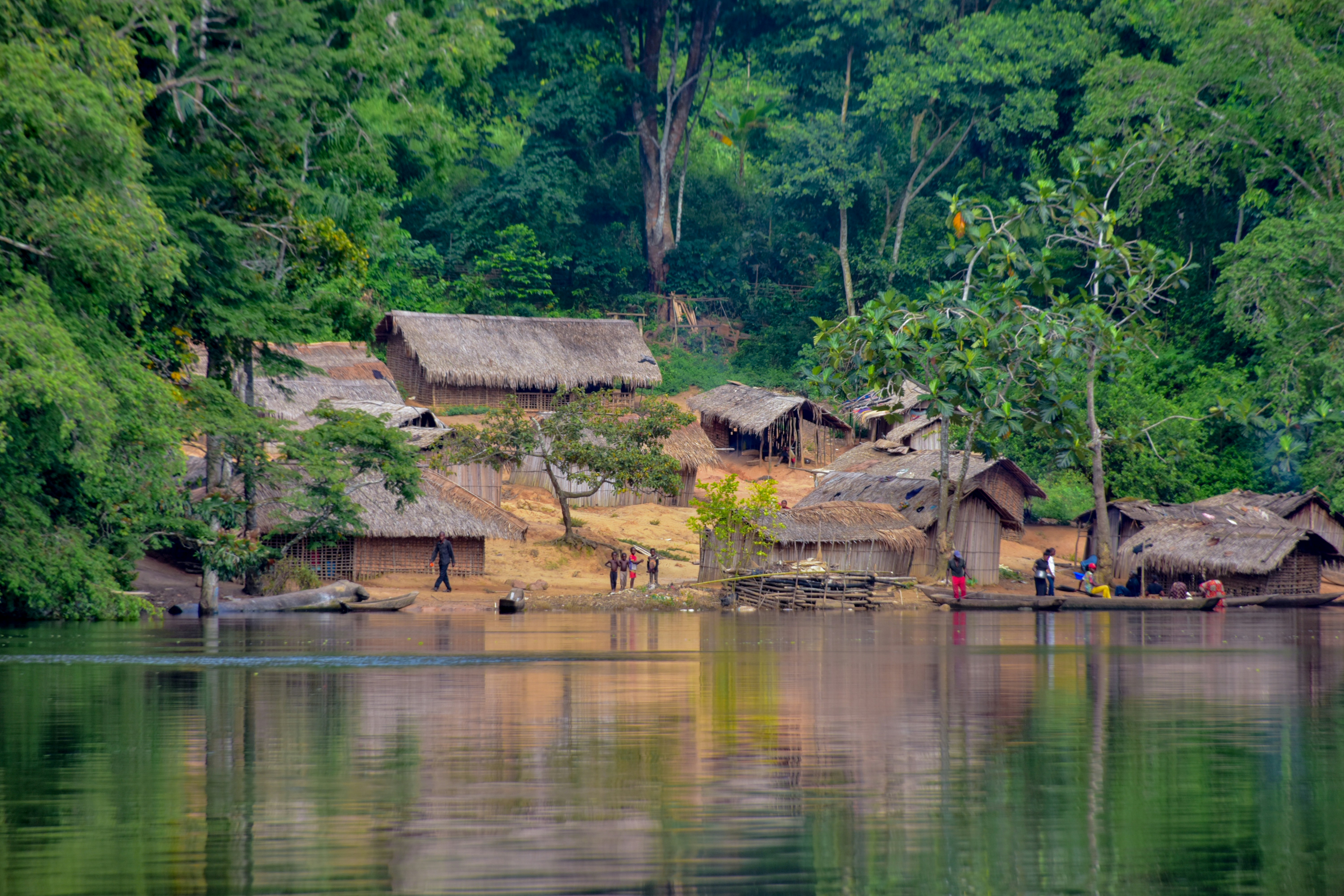
This October, Welsh explorer Ash Dykes set off to navigate 700 kilometres of the Sangha River through the Congo Basin in an inflatable kayak. His route ran from Nola in the Central African Republic to Mossaka in the Republic of the Congo, through territory inhabited by elephants, gorillas, hippos, and crocodiles. This journey went viral on TikTok, garnering millions of views and achieving his goal of bringing attention to the diverse communities and wildlife that live along the river.
Dykes’s journey also passed through a region central to international efforts to protect tropical rainforests. Several countries in the Congo Basin participate in the Central African Forest Initiative (CAFI), which supports forest conservation through funding for sustainable land use, including payments for ecosystem services (PES). These programmes provide financial incentives to farmers and rural communities for adopting sustainable practices, such as agroforestry, reforestation, and forest conservation. But delivering payments to remote communities and enabling them to take part in digital transactions depends on reliable power and connectivity, both of which are often unreliable in this region.
The economics of PES
Payments for ecosystem services (PES) are voluntary agreements in which land users receive payments in return for providing a defined environmental benefit, conditional on delivering the agreed service. The principle is essentially a performance bonus for keeping trees standing. Rather than clearing forest for agriculture, a farmer can earn income by maintaining forest cover.
For these incentives to work, participants need to know that agreed payments will reach them reliably. The costs of negotiating agreements, monitoring compliance and administering payments can undermine a scheme’s economic viability, even when protecting the forest would generate wider environmental benefits. This problem is particularly acute in remote areas, where reaching participants and delivering payments can be expensive. Whether PES can work at scale therefore depends not only on the incentives it offers, but also on the cost and reliability of the systems used to deliver them and verify the results.
The challenges of reaching remote communities are evident in Dykes’s experience in the Congo Basin. Although Dykes successfully completed the journey, he faced technical problems when his Starlink connection and power bank failed. A generator that Dykes and his crew found in a riverside village had also broken down, leaving them unable to recharge their equipment. For over 16 hours, he was unable to communicate with his team, prompting fears online about his safety. The incident highlights how even well-funded, professionally equipped expeditions can struggle to maintain reliable power and connectivity in the Congo Basin.
Despite these challenges, evidence suggests PES can reduce forest loss. In a randomised trial across 121 villages in Uganda, villages offered payments to preserve forests experienced around 54% less tree-cover loss over two years than villages without the programme, with no evidence that deforestation had shifted to neighbouring areas. A separate experiment involving 1,200 forest users found that conservation behaviour remained higher, on average, even after payments ceased. Having established that PES has the potential to work, the question becomes how best to put it into practice.
What is the best way to deliver PES?
Two approaches offer contrasting answers. The first, used by the Central African Forest Initiative (CAFI), relies on existing financial services, such as mobile money, to transfer funds to participants once conservation requirements have been met. The second proposes blockchain technology to record transactions and, through smart contracts, release payments automatically when specified conditions are satisfied.
CAFI and mobile money
CAFI is a multi-donor trust fund supporting forest protection and sustainable land use across six Central African countries. It has committed $245 million to the PES programming pipeline, with $75 million allocated to approved projects. Its PES model follows five steps: enabling communities to participate, agreeing contracts, implementing and monitoring activities, checking results, and making direct payments. Monitoring draws on field data, geotagged evidence, and satellite reporting. Once environmental results have been verified, participants can receive payments directly through their chosen mobile money operator or bank, with the PES Management Tool supporting delivery.
The approach builds on existing financial services rather than requiring participants to adopt new payment systems. In 2025, CAFI tested the full process in the Democratic Republic of the Congo (DRC) and the Republic of the Congo, making its first payments to participating communities. By the end of this initial phase, 31 contracts covered 952 hectares, with approximately $4,000 paid in total.
The 2025 pilot demonstrates that CAFI’s model can work in practice, but scaling it requires reaching communities that remain poorly served by financial infrastructure. Mobile money offers a practical starting point because it uses existing operators and accounts, while digital systems can reduce the administrative costs of registering participants and processing payments. Yet access remains limited, with some communities lacking mobile coverage and only 39% of adults in the DRC holding a bank or mobile money account in 2024.
Blockchain and automated payments
An alternative to mobile payments is to use blockchain-based systems to automate the link between conservation results and payments through smart contracts. These programmes release funds when predefined conditions are met, potentially reducing administrative costs and making payment conditions and transactions more transparent to both funders and participating communities.
A 2019 proof of concept in Namibia examined how satellite data on an elephant corridor could trigger smart-contract payments to surrounding communities. The system linked remote-sensing algorithms to a blockchain, automating the assessment of habitat change and the release of funds where conservation conditions were met. This approach reduces the labour and expense involved in monitoring and administering payments. The authors also identified important limitations. For example, satellite images can track land clearance, but cannot establish whether the elephants are using the corridor. Additional monitoring remains necessary, and implementation requires specialist expertise. The system’s effectiveness depends on how well automated payments integrate with wider monitoring and management.
Blockchain also offers a method to coordinate payments across multiple funders. In one example, the World Food Programme’s Building Blocks system uses a shared digital ledger to coordinate humanitarian assistance across agencies. It has processed $555 million in cash-based transfers and saved $3.5 million in bank fees. In Ukraine, 18 organisations used the system for over four months in 2022 to prevent $35 million in overlapping aid payments, freeing resources to support an additional 185,000 transfers.
This model is relevant to CAFI, where multiple donors fund conservation across the same landscapes. A shared ledger could give funders a common record of transactions, making it easier to reconcile contributions and track how much money moves through the programme.
Which approach fits the Congo Basin?
For CAFI in the Congo Basin today, mobile money is the more practical foundation. It already supports payments through existing financial services. That being said, gaps in mobile coverage and account ownership limit its reach. Blockchain could complement this infrastructure by improving coordination between donors, automating payments, and strengthening trust through greater transparency over how funds are allocated and disbursed.
Ultimately, the choice of payment system does not determine whether conservation finance achieves its intended result. Both approaches depend on reliable monitoring and credible evidence that conservation commitments have been met. Carbon markets are an illustrative example of what happens when the development of financial infrastructure outpaces the methods to measure environmental outcomes.
Carbon markets: the limits of financial infrastructure
REDD+ (Reducing Emissions from Deforestation and Forest Degradation in Developing Countries) channels finance towards forest protection. Projects can generate carbon credits, which companies can then purchase to offset their own emissions, by demonstrating that they have prevented deforestation and the associated emissions.
Measuring these avoided emissions requires estimating how much deforestation would have occurred without the project. A 2023 study examined 26 voluntary REDD+ project sites across six countries. For the 18 projects with sufficient baseline data, the researchers estimated that only around 7% of potential carbon credits represented additional emissions reductions. The authors attributed the gap largely to inflated deforestation baselines. As a result, projects issued credits for emissions reductions not actually realised. This exposes a gap between the systems used to generate and trade carbon credits and the methods used to verify their environmental value.
Blockchain platforms have accelerated the development of financial infrastructure by making carbon credits easier to trade. Toucan, for example, is a technology company that converts conventional carbon credits into digital tokens that can be transferred and traded on a blockchain. It initially did this using credits from Verra, a non-profit organisation that operates a major carbon-crediting programme and maintains a registry of verified credits.
Toucan tokenised over 20 million Verra credits, including older credits from projects with limited evidence of environmental benefits. This brought renewed demand for credits that struggled to attract buyers in conventional markets. In May 2022, Verra banned the conversion of its retired credits into crypto tokens, citing concerns about market integrity. The episode further highlights how financial infrastructure can expand trading and create new demand before establishing the environmental value of assets being traded.
Concluding thoughts
Dykes’s expedition exposed the difficulty of maintaining reliable power and connectivity in remote parts of the Congo Basin. For conservation finance, similar gaps in infrastructure can make payments costly, delayed, or difficult to deliver. Mobile money and blockchain offer ways to deliver and coordinate payments across remote areas, but their effectiveness still depends on infrastructure that can verify the environmental results those payments reward. Financial incentives can help make forest protection viable for communities, but only if the promised payments arrive reliably. CAFI’s challenge is to build a system that delivers those payments and verifies that the forests they reward are being protected.
The views expressed in this article are the author’s own and may not reflect the opinions of The St Andrews Economist.
Image credit: Unsplash