
By Carmen Segovia Fernandez
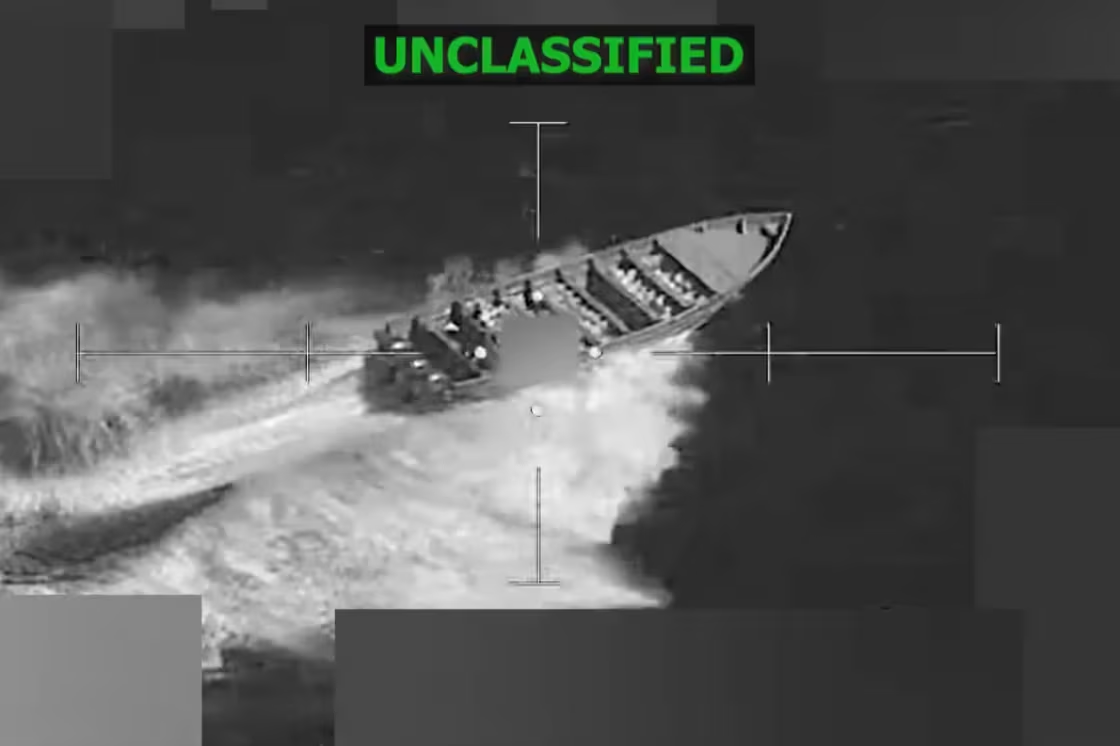
Renute Roberts, a fisherman from Trinidad and Tobago, has, since September, been reluctant to go fishing; he fears US drones will mistake his wooden vessel for a drug boat. On the 8th of August of this year, President Trump signed a secret directive authorising the Pentagon to use military force against Latin American drug cartels. Unsurprisingly, a month later, the US military carried out various strikes, attacking alleged drug vessels off the coast of Venezuela and causing multiple casualties. Colombia and Venezuela have denounced the strikes as illegal and declared the killings extrajudicial.
The president’s actions come from a long trend of American foreign policy pushing for militarized drug control measures to fight the illicit maritime drug trade. However, using military force has only proven to be a short-term solution to a long-lasting issue and has been criticized by the international community.
The actions carried out by the Trump Administration can be condemned from various angles. Firstly, from a legal standpoint, the UN Convention on the Law of the Sea (UNCLOS), generally accepted by the US as customary international law, states that “the high seas should be used for peaceful purposes” only, thus making the US’s actions a clear breach of UN regulation.
Second, the militarisation of drug trafficking does not target the root causes of illicit trade and, alone, cannot significantly destabilise well-established drug trafficking networks. For example, demand can be seen as one of the root causes of illicit trade, and it is on the rise. In 2023, 74,702 Americans died from fentanyl overdoses alone. Targeting demand through techniques like addiction treatment rehabilitation might decrease demand and, in turn, reduce the economic incentives keeping maritime illicit trade booming, something militarization falls short on.
In parallel, supply is booming too, with Colombia producing 2,664 tonnes of cocaine in 2023. This is linked to a range of factors. One of the most significant determinants was in 2016, when President Santos introduced a scheme for the substitution of coca crops with non-illicit plants, by giving peasants government subsidies to encourage them to make this change. This policy, however, backfired since an increasing number of farmers started cultivating cocoa in order to qualify for the subsidies given for crop replacement. Another contributor was in 2022, when President Ptero introduced his “Paz Total” policy, which aimed at dealing with armed groups only diplomatically. This policy also ultimately backfired since over the 4 years of Petro’s presidency, armed groups grew, violence increased, and coca cultivation soared. These factors have facilitated increased production, thus allowing for sustained high maritime exports of cocaine to international markets.
With supply and demand on the rise unchallenged, it is evident that militarised drug control only puts short-term pressure on the complex network of illicit maritime drug trafficking. Militarization is inefficient mainly because illicit maritime drug trafficking is heavily fragmented. It often involves multiple criminal organizations and an array of different trafficking techniques, ranging from hiding drugs in shipping containers to pasting them under the hull of ships to later be recovered by divers who deliver them to smaller fishing boats. Consequently, striking one cargo boat will not really disrupt the production chain.
Lastly, the actions carried out by the White House in September of this year also had important geopolitical repercussions. The Trump administration officially declared that the country of Colombia had failed to cooperate in combating narcotrafficking, removing the country’s certificate as a reliable security partner, a measure that also allows the US to cut funding for Colombia. Moves like this only exacerbate distrust in the already unstable region, driving countries further away from the possibility of cooperation. Deterring foreign cooperation and investment in the region presents a real obstacle to achieving non-militarized solutions to tackling narco-trafficking, as multilateral collaboration, such as information and intelligence sharing, is a crucial component of fighting the cross-border war on drugs.
Alternative maritime security strategies focusing on collective action and governance are now explored, as means of showing that there are effective alternative to militarization. A good example of this is the ongoing Colombia-led Operation Orion, which, since its start in 2018, has successfully seized up to 1400 tonnes of drugs in 2024. Moreover, through its transnational intelligence, monitoring, and law enforcement capabilities, all of which fundamentally rely on trust between participating members, Orion can better understand the inner workings of trafficking networks and thus carry out more precise operations. As the EU’s Maritime Analysis and Operation Centre argued, collective action in this field is essential “because it takes a network to combat a network”.
Another maritime security strategy alternative to militarized drug control is the Caribbean Maritime Security Strategy (CMSS). This project is currently under development, but once in full force, it aims to “protect Caribbean Maritime Interests, by bolstering maritime security and governance to promote prosperity for all”. Similar to Orion, CMSS focuses on creating a security, technology, and information-sharing network between stakeholders to better understand and approach maritime threats in the region. Additionally, CMSS also aims at developing and protecting Caribbean economies and populations, most of whom heavily depend on maritime resources for survival. In this light, CMSS directly reduces issues like poverty and unemployment, part of the root issues that keep drug trafficking going. This then decreases the need for locals to engage in maritime illicit trade themselves, directly targeting the underlying causes that allow illegal trade to thrive.
Illicit trade cannot be battled through the militarization of drug control. As evidenced by Orion’s success, maritime security strategies based on collective action and governance are better suited to battle this threat. I now appeal to the Trump Administration and other like-minded governments to join the collective action route and further develop multilateral intelligence, tracking, and information systems to successfully put an end to the war on drugs.
The views expressed in this article are the author’s own and may not reflect the opinions of The St Andrews Economist.
Image Credit: U.S. Southern Command