
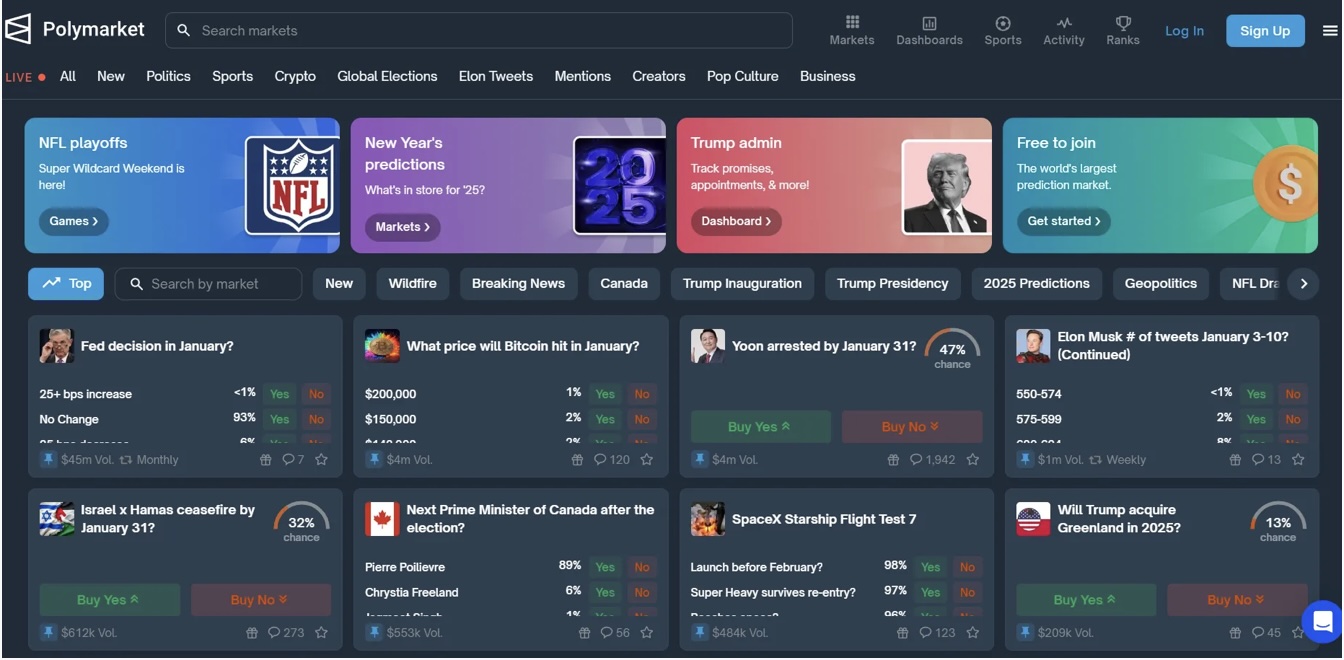
By Thomas Gorbold
In March 2026, prediction markets processed more than $25bn in trades — roughly thirteen times the level recorded a year earlier. Two years ago, few outside reddit forums had heard of Polymarket or Kalshi. Today, their odds are cited alongside polling data in the Financial Times and The Wall Street Journal.
What has changed is not the human desire to bet on uncertain outcomes, but the legal wrapper around it. By classifying wagers as “event contracts”, these platforms have recast betting as a form of trading — one that sits increasingly closer to financial markets than to casinos.
What is a Prediction Market?
Prediction markets allow users to trade binary contracts on future events. A contract that pays $1 if an outcome occurs trades somewhere between $0 and $1; a price of $0.60 implies a 60% probability. Unlike traditional sportsbooks, prices are not set by a bookmaker. They emerge from trading between participants.
Sportsbooks build margins — often 5–10% — into their odds. Prediction markets, by contrast, operate more like exchanges: users trade against one another while the platform collects a smaller transaction fee, typically around 2%. The result is tighter pricing and, in theory, odds that better reflect collective expectations.
Nor is the attraction limited to lower costs. Previously, a trader who believed a political candidate would win might buy equities expected to benefit from that outcome. Now they can trade the outcome itself in real time, with continuous price discovery. On several platforms, cash held in accounts also accrues an annual yield of roughly 3.25%, reducing the opportunity cost of holding contracts.
A Federal Advantage
Prediction markets owe their rapid growth as much to regulation as to technology. Event contracts are generally treated as derivatives, placing them under federal oversight — primarily that of the Commodity Futures Trading Commission — rather than the patchwork of state gambling laws that govern sportsbooks.
Sports betting remains legal in only 39 states and Washington, D.C., forcing traditional bookmakers to navigate separate licensing systems, state taxes and compliance costs. Federally regulated exchanges can, in principle, operate under a single national framework. That alone removes a substantial layer of legal and administrative expense.
A second advantage lies in the mechanics of the product itself. Sportsbooks employ traders, quantitative teams and risk managers to build odds, monitor exposure and preserve the bookmaker’s margin. Prediction markets outsource that function to the market. Users set prices by trading against one another while the platform simply collects a transaction fee. The result is a structurally cheaper model.
Those savings show up in pricing — and in growth. According to the Financial Times, Kalshi’s monthly active users rose from roughly 600,000 to over 5 million in a single year, while its sports contracts generate an estimated $1.3bn in annualised revenue. Now other operators are copying the model. DraftKings, FanDuel, Fanatics, Robinhood and Coinbase have all moved to offer event-contract products.
The Insider Problem
If prediction markets resemble financial markets, they inherit their central problem: information asymmetry.
Many prediction contracts are tied to events with no formal disclosure regime. There is no requirement to release material information about a military strike, a regulatory decision, or a private negotiation.
Polymarket is blockchain-based, but in certain regions users can trade without identification documents, leaving suspicious bets visible while the people behind them remain anonymous.
The Financial Times identified twelve suspicious accounts on Polymarket that made a combined $330,000 profit on contracts tied to US air strikes on Iran, roughly half of it in the six hours before the attack. A near-identical pattern emerged around the US capture of Nicolás Maduro in January, where six newly opened accounts staked $9,807 on contracts that paid out $133,878. In February, Israeli authorities indicted a military reservist and a civilian for allegedly using classified intelligence to trade on the timing of strikes against Iran; one account reportedly netted $150,000.
The risk is not limited to private information. In France, Météo-France filed a police complaint after temperature readings at Charles de Gaulle airport spiked within minutes, coinciding with well-timed Polymarket bets on Paris weather. One wallet reportedly made more than $21,000 from a $119 stake.
If participants believe a market is distorted by too much asymmetric information, they will stop trading in it. Yet rising trading volumes suggest users are willing to tolerate that risk.
Here to Stay
Prediction markets are neither purely financial nor purely recreational. They borrow the incentives of trading and the accessibility of betting. That mix explains both their growth and the unease around them.
The industry also has more room to operate than it did a few years ago. Polymarket is back in the US, and Donald Trump Jr. now advises both Kalshi and Polymarket. None of that guarantees permanence but it does give the industry room to grow.
The risks should not be brushed aside. These platforms are fast, intuitive and increasingly gamified. As with stocks or crypto, users can lose their entire stake. But financial innovation often arrives before regulators know how to classify it. The danger is twofold: move too slowly and consumers remain exposed; move too aggressively and a useful market may be smothered before it matures.
Prediction markets have already changed how people bet, how probabilities are communicated, and how financial platforms compete. Their case remains simple: cheaper bets, open probabilities and real-time forecasts available to anyone. The next few years will determine whether they are allowed to reach their potential, and whether the rules around them are built to last.
The views expressed in this article are the author’s own and may not reflect the opinions of The St Andrews Economist.
Image Credit: tradersunion.com