
By Trent Griger
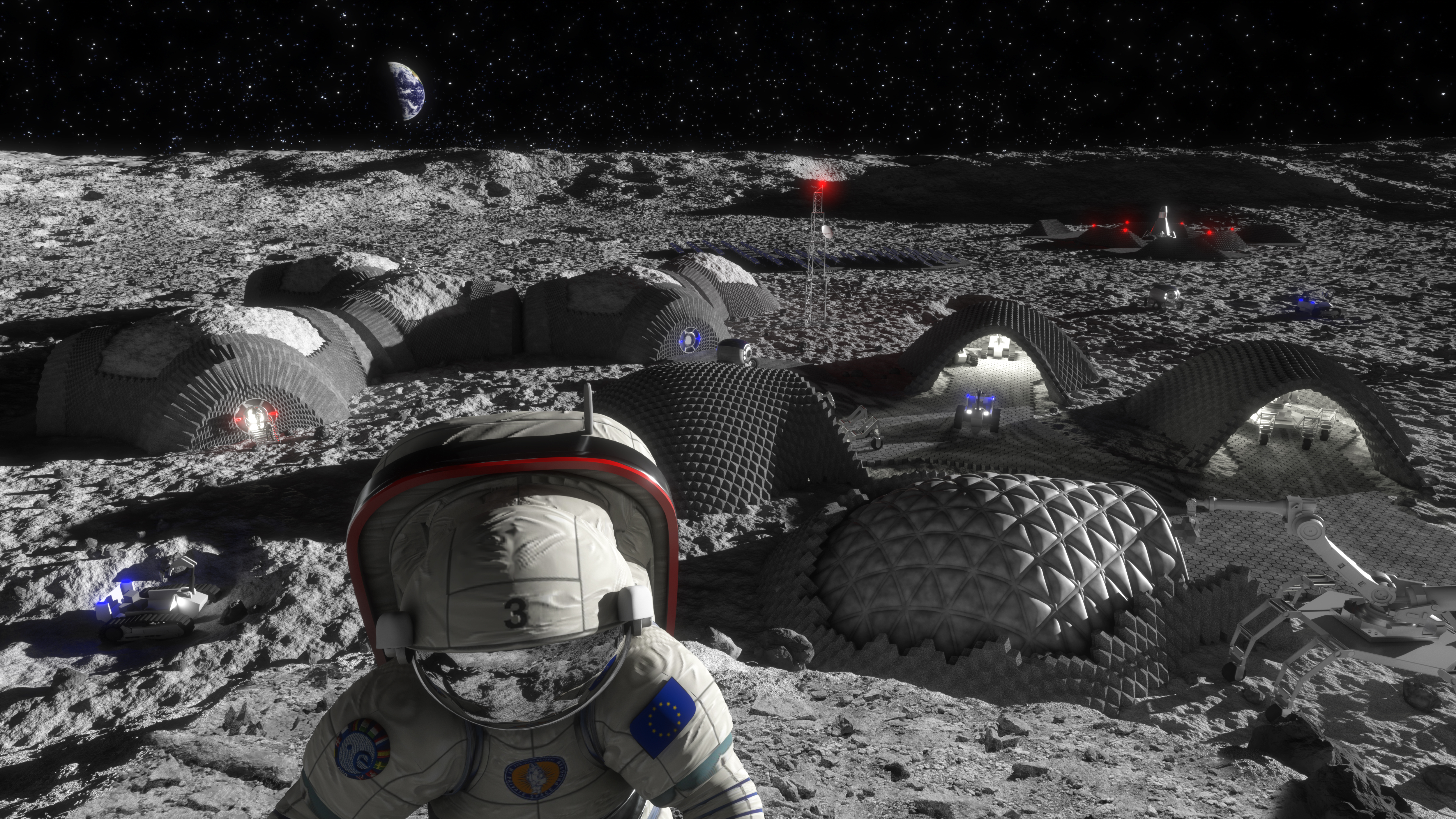
Permanent or semi-permanent human habitation on the Moon sounds like something ripped straight from a sci-fi novel. Think massive bubbles packed with scientists and engineers working hundreds of thousands of miles away from Earth for the betterment of mankind. But according to NASA, they plan to make this a reality by 2030.
The agency’s bold declaration is a direct response to Trump’s National Space Policy issued in December 2020 and his more recent executive order titled “Ensuring American Space Superiority” issued in December 2025. Both of these policies focus chiefly on expanding the American presence in space, returning to the Moon, and expanding the commercial space industry. One of the key methods they seek to go about this is via the founding of a Moon base.
The idea of a Moon base is not new. NASA has considered early plans for lunar housing as early as 1959, a decade before man ever walked on the Moon. Locations for a full base were staked out and planned all the way back in 1962, placing it near the mouth of a large crater. It raises the question, if we’ve been thinking about it for so long, why haven’t we done it yet? Why has the moon been left uninhabited?
The obvious answer is that the technology simply has not been at the level it needs to be to provide confident answers in response to the Moon base question. It was only 2023 when NASA and the Italian Space Agency (ASI) signed a contract with the European company Thales Alenia Space for the development of a lunar habitation module. There’s also the matter of the rockets used to get there, a field that has also seen a great amount of innovation in the past decade, especially thanks to NASA’s partnership with companies like SpaceX. According to NASA, the commercialization of the space industry fosters innovation and drives down their own costs. While private companies have been involved in the space industry since the very beginning, it’s only more recently that these companies have been making major strides in innovation on their own. The private sector expansion is one of the key drivers behind making a Moon base more feasible today than ever before.
Technological development is not the only thing holding back permanent human lunar habitation. We also need a reason to be there in the first place. The commercial sector once considered mining the Moon for minerals and volatiles, chiefly liquid oxygen, that could be sold to a captive audience (the colonists living there) for exorbitant prices. While this sentiment has not gone away, and there are indeed still companies investing in technology to do this, it is not the driving force behind NASA’s new push for Moon habitation. To uncover the motives behind their new push, we must look to China.
The China National Space Administration (CNSA) has made immense progress in the past decade, quickly reaching a level that is arguably on par with or catching up to the US. Indeed, they have their own Moon base planned in partnership with the Russian space corporation Roscosmos. The proposed International Lunar Research Station (ILRS) would begin construction in 2030, conspicuously the deadline given by President Trump for when he wants America’s own Moon base. Given the broader geopolitical tensions between the US and China recently, it may be that the two superpowers are gearing up for another space race, where the goal is no longer just to land on the Moon, but rather to have a permanent presence on the surface.
NASA’s plan to beat China to the Moon has three phases. The first is a massive increase in the frequency of unmanned missions to the surface, deploying rovers, scientific instruments, and general technology demonstrations. These will increase the overall American presence on the surface and serve as a proof of concept for an increase in lunar infrastructure. Second, a move towards semi-habitable infrastructure and recurring, albeit brief, astronaut missions to the surface. Finally is the transition from periodic expeditions to full time habitation, utitlizing the previously mentioned lunar habitation module developed in coordination with ASI. Cooperation with allied space agencies is key to every step of development, and it’s a promising sign for what an inhabited Moon may look like. This is doubly true if this new space race ends in a similar fashion to the old one, with opposing sides joining together to combine their knowledge and technology, furthering the cause of humankind.
While neither NASA nor the US government have stated specific goals for the lunar base aside from “increased American presence” the possibilities for what it may become are numerous. The first and most certain iteration will be a scientific institution. NASA plans on using the lunar base to test technology that will enhance further space exploration, from growing human presence on the lunar surface all the way to a possible future on Mars. Another guarantee will be the commercial prospects. The European Space Agency, a close ally of NASA, has opened opportunities for business ventures that will enhance not only the lives of those on the Moon, but may have benefits to those on Earth via communication and data transfer services or other methods. The most concerning possibility is, of course, the military applications. The militarization of space has been an ongoing phenomena since the dawn of the space age. It may be naive to expect any different from a human presence on the Moon. The best hope we may have to prevent catastrophic loss and escalating conflict both on Earth and abroad is to establish a comprehensive set of laws to govern a shared lunar space, before any nation fully establishes themselves.
A lunar base has been promised before, but never has there been this much pressure to deliver. With the full realization of all necessary technologies, and a geopolitical rival they must beat, NASA is poised to realize their goals of putting man back on the Moon, permanently this time.
The views expressed in this article are the author’s own and may not reflect the opinions of The St Andrews Economist.
Image Credit: Wikimedia Commons