
By Maura Lucke
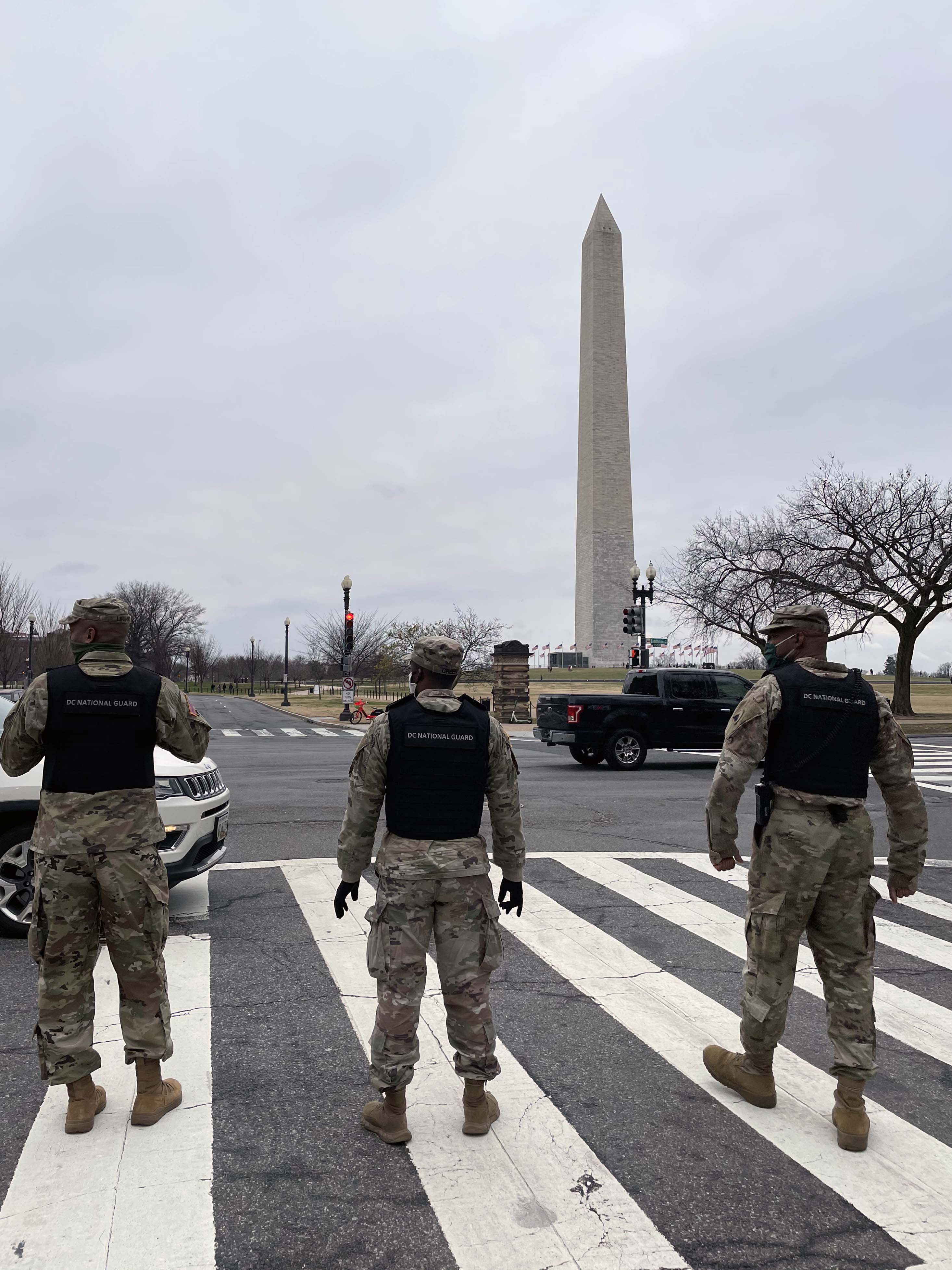
Since August, the National Guard has collected 1,142 bags of trash, spread 1,045 cubic yards of mulch, pruned 400 trees, and painted 270 feet of fencing in Washington D.C. In addition to taking selfies with tourists, the National Guard has executed beautification projects throughout the United States’ capital. The White House controversially extended the Guard’s occupation until February of 2026, prompting debate over the limits of presidential power.
Traditionally, the National Guard is used sparingly, requested by a state’s governor in case of a natural disaster or emergency. President Trump’s administration has sharply deviated from these norms. In the span of just six months, the White House deployed troops to five U.S. cities, including Washington D.C., Los Angeles, and Chicago, and threatened deployments to several others. Critics of President Trump argue that the expansion of federal authority increasingly politicizes federal troops.
President Trump justifies the deployments as necessary to crackdown on the supposed epidemic of crime and lawlessness in American cities. Yet the data offers a contrasting reality. In Washington D.C., violent crime is down 26% compared to the same period in 2024, and robbery is down 28%, according to the Metropolitan Police Department. While Chicago does have a reputation for high crime rates, the city ranked below the top 50 cities in the U.S. for violent crime. In Portland, crime has been on the decline since 2022. President Trump’s portrayal of urban chaos is out of touch with reality.
However, the case can be made that the mere presence of the National Guard members deters crime. Crime rates have dropped where the Guard has been deployed, including in Washington D.C. However, the president of the National Policing Institute, Jim Burch, points out that “any city in America with a 50% increase in their officers is going to have an impact on public safety” and the National Guard is not uniquely equipped to handle ground situations any more than local officers. In addition, costs are mounting. Based on the known spending so far, National Guard deployments could end up costing American taxpayers around two-thirds of a billion dollars. Moreover, the overreach of federal troops increasingly erodes the local police force as well as community trust. Polling from NPR shows Republicans overwhelmingly support troop deployments to cities, while Democrats largely oppose them, adding fuel to the partisan divide in American politics. Regardless of its short-term effectiveness, using the National Guard to manage crime is unsustainable for the federal government to maintain and needlessly politicizes the military.
Additionally, the blurred lines between the responsibilities of ICE (Immigration Customs Enforcement) and the National Guard creates chaos. President Trump repeatedly conflates crime and immigration into a single crisis. The White House’s official website labels illegal immigration as an “invasion” on American soil—language that implicitly invites military action. In a speech to top ranking military generals in September, Trump described using U.S. cities as military training grounds and attacking the “enemy from within”, in reference to illegal immigration.
As the administration ramps up immigration enforcement, protests have erupted against ICE, and those protests serve as a pretext for the Trump administration to justify sending in the National Guard. U.S. District Court Judge April Perry highlighted what she called a “troubling trend” of the President Trump administration “equating protests with riots”. Portland, Oregon is a prime example of how peaceful protests were conflated with civil rebellion by the Trump administration. Confrontational protests occurred outside of the U.S. Immigration and Customs building in Portland, according to the Portland Police Bureau. However, Portland’s police chief described the protests as “largely nonviolent and contained”. In contrast to this statement, President Trump called the city “war-ravaged” and claimed it was under attack from “domestic terrorists”. Clearly, President Trump is attempting to shape American perceptions of disorder to rationalize the deployment of federal troops.
Many in the legal system are pushing back against President Trump’s claims of lawlessness in U.S. cities. On November 8th, President Trump’s deployment of the guard to Oregon was decidedly blocked by the court system: the judge ruled that there was neither a rebellion or danger of a rebellion which justified national guard intervention. President Trump will appeal to the Supreme Court, which could set a new precedent in time. However, President Trump has another avenue to achieve his ends: the Insurrection Act.
Under U.S. federal law, The Insurrection Act grants the president authority to deploy the military domestically in cases of uprising. Currently, under the Posse Comitatus Act, the U.S. military is barred from performing domestic law enforcement functions. The National Guard cannot make arrests and can only assist ICE. Yet, this restriction would be suspended in times of crisis, a detail President Trump appears poised to take advantage of. On October 29, President Trump told reporters, “I could send the Army, Navy, Air Force, Marines—I can send anybody I wanted,” adding that if he invoked the Insurrection Act, “no court orders would interfere.” This raises the alarming possibility the National Guard being used for immigration enforcement with few constitutional checks.
Using the Guard for immigration control has long been a goal of President Trump’s adviser, Stephen Miller. In 2017, during President Trump’s first term, the Associated Press obtained a DHS memo outlining a proposal to use the Guard to round up undocumented immigrants across the country. Currently, Project 2025, a conservative agenda, views the National Guard as an untapped resource to go after illegal immigration, presenting it as a national security issue. The reality of using the federal troops to manage immigration may not be far in the future.
Further escalating tensions, the Pentagon recently ordered the creation of a Quick Reaction Force for Civil Unrest on August 9th. This requires states to train a nationwide total of 23,500 troops in “riot control”, which includes the use of batons, body shields, and pepper spray. Additionally, the White House opened an online portal accepting applications for a specialized unit dedicated to ensure public safety: which could be deployed to D.C. and other cities where “order has been lost”. These new policies suggest President Trump’s deployments are not carried out on a whim, but instead actively built up in anticipation of future use.
Deploying the National Guard to American cities to fight crime is costly and unnecessary—unless the long-term goal is something else entirely. If the administration’s aim is to normalize the Guard’s presence for future immigration enforcement, then these “beautification projects” are merely camouflage. President Trump appears to be conditioning the public to accept a militarized presence in everyday American life.
The views expressed in this article are the author’s own and may not reflect the opinions of The St Andrews Economist.
Image Credit: Air National Guard