
By: Nachiket K Javali
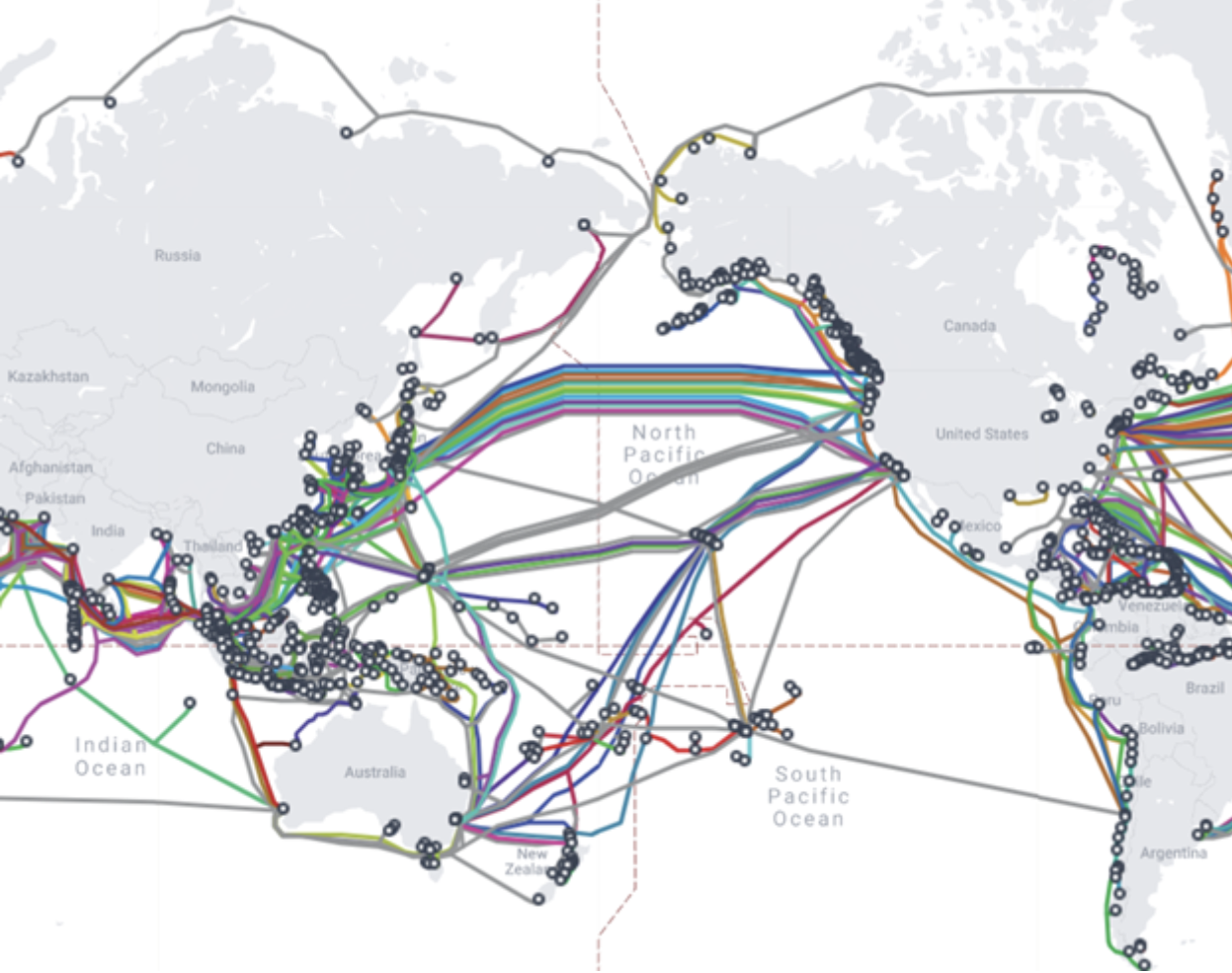
The Indo-Pacific region is a significant geopolitical location – at least 60% of the world’s shipping trade passes through the region. It is home to emerging players like India, regional giants like China and Japan and has also attracted significant interest from Western powers like the US and France. More importantly, the region is home to one of the most advanced networks of undersea cable infrastructures which includes countries such as Japan and Singapore.
Despite their inconspicuous nature, undersea cables are the backbone of global digital communications today, carrying 95% of international data traffic. They invisibly facilitate bank transfers and the transfer of sensitive data. International banking structures and satellite systems are supported by undersea cables, that connect not only countries but continents with their vast networks. For instance, the Society for Worldwide Interbank Financial Telecommunication (SWIFT) sends around 20 million messages to more than 8,000 banks to almost 200 sovereign territories through this very network. Disruptions to this network can be catastrophic to the global economy. As global internet usage expands, the demand for secure and resilient undersea cables is expected to increase given that almost 70% (5.5 billion) people today can access the internet.
The Indo-Pacific although vast, comprises of significant sub-regions that are relevant to the global undersea cable network. The South China Sea for example is critical with cables linking major economies like Singapore, Japan, and China. However, China under Xi has become increasingly assertive in the region, making the protection of undersea cables an imperative for global powers like the US. The rise in China’s militarisation in the region is seen as a cause for concern by like-minded organisations like the ASEAN and structures like the Quad to establish secure cable networks.
Disruptions to subsea cables are not new, but their consequences are severe. For example, in February, 2023, Chinese vessels allegedly damaged undersea cables near the Matsu Islands of Taiwan, 20 kilometres near the coast of mainland China. This was quite damaging for the residents of Matsu Islands, who only received access to full internet on March 31. It could be argued that these are one of China’s grey zone tactics against Taiwan, as the island becomes warmer towards the United States. Considering these probable security concerns, the US has sought to create alternative seabed cable routes that bypass water surrounding China. For example, it has asked technology giants like Google and Meta to participate in the creation of cables through Indonesian and Filipino waters to reach American territories like Guam and California.
Southeast Asia’s location in the Indo-Pacific illustrates how critical the region for the global economy in terms of undersea cables. The Strait of Malacca for example, records around 90,000 vessels every year. The Association of Southeast Asian Nations (ASEAN) recognised the importance of undersea cables as early as 1999, when they launched the South East Asia-Middle East-Western Europe 3 (SEA-MEWE 3) cable that involved more than thirty countries at the time. In 2009, Southeast Asia looked towards the Pacific through the Asia-America Gateway cable that connected Hong Kong, Guam, and Hawai’i. The region has also invested in this for the future with the Asia Connect Cable planned for 2027. This cable will integrate the systems of Australia, Southeast Asia, and the US through the Java Sea.
Interestingly, since 2009, Southeast Asia has been looking towards alternative routes than the South China Sea and the Taiwan Strait. These considerations are significant due to these waters’ geopolitical vulnerability in recent times with an aggressive China in the making. China’s impact is being felt on current cable developments. For example, the Southeast Asia-Japan 2 (SJC2) cable network has faced significant delays due to China’s claims in the region, prompting a detour via the Pacific Ocean from Indonesia.
These regional dynamics are altering undersea cable ownership in the South China Sea. HMN Technologies, a Chinese submarine cable provider has reaped the benefits of this geopolitical situation. It denies companies from Japan and the US to make inroads in the region. HMN Tech has also been praised by the ruling CCP for its works on civil-military integration. Such words only make China’s adversaries wary of its ambitions and capabilities in the region as trade wars and excess militarisation are becoming the norm between China and the US.
The US-China power rivalry also manifests itself in the fight for securing undersea cable lines. While espionage claims against Chinese firms carry some element of credibility, American intentions to secure contracts must also be scrutinized. Many American naval ships have acquired capabilities to tap undersea cables since as early as 2005. The role of the National Security Agency is relevant in pressuring social media platforms, that are mostly American today, to hand over sensitive information. American cooperation with Google, Meta and Microsoft exemplifies this link.
Apart from cooperation with tech giants, America is utilising formal diplomatic platforms to lobby and devise policies to contain China’s growth in the undersea cable business. For example, as part of the Quad, one of America’s many platforms to establish its presence in the Indo-Pacific, it benefits from the ‘Quad Partnership for Cable Connectivity and Resilience’. Australia will develop this program that also extends to small South Pacific Island countries like Micronesia along with American technical expertise through its CABLES program. The Quad, apart from the US, comprises of Japan, Australia, and India, all of whom who are currently experiencing tensions in their respective relations with China. This nature of the Quad allows the US to partner with these powers of the Indo-Pacific and mobilise collective action against China’s might.
The importance yet vulnerable nature of undersea cables is now at the heart of an emerging power struggle with the complex geopolitical Indo-Pacific region. However, the current international legal structure has done little to protect their invisible yet indispensable characteristics from grey zone tactics and aggressive behaviours. Major countries like the US are not part of existing legislations that protect undersea telecommunications. As Sino-US tensions become more visible in the undersea cable industry, this technology is being used to divide the world like the Cold War era. The US with its diplomatic ties is trying to convince its partners in Asia to limit cooperation with China. However, powers like India and ASEAN’s economic dependence on China must not be ignored and is something that both emerging powers are reluctant to let go of. It is quite paradoxical for a technology like undersea cables to become tools of great power struggle in contemporary international relations given that these tools echo the fruits of a more connected and globalised world today.
The views expressed in this article are the author’s own and may not reflect the opinions of The St Andrews Economist.
Image from Google via Telegeography, 2024. Some rights reserved.