
By Aleyna Taber
Border cities such as Ciudad Juárez are epicenters for foreign – especially US owned – assembly factories called ‘maquiladoras’, where nearly 70% of local exports are destined for US markets. Enabled by the North American Free Trade Agreement (NAFTA) in the 90’s, the Mexican economy has grown increasingly reliant on US-outsourcing. Maquiladoras have come to play a central role as a result, now accounting for roughly 60% of manufacturing GDP, 20% of overall GDP, and 50% of industrial employment. Ciudad Juárez alone has about 300 maquiladoras, producing everything from clothing and light electronics to components for the medical, automotive, and aerospace industries.
Alongside the flourishing of the border city’s maquiladoras in the 90’s and early 2000s, Ciuddad Juárez simultaneously became infamous for its femicides with over 400 women killed in less than a decade. Unfortunately, the concerning numbers of gender-based violence in the city continues to grow with more women being murdered in Juárez than ever before, reaching close to 500 deaths in only 3 years.
It is no coincidence these two renowned aspects of Ciudad Juárez both flourished around the same time, either. Indeed, the main demographic of maquiladora workers are women, many of whom are often found dead on the street, naked, tortured, mutilated to the point where their bodies are unrecognizable. Yet, what is the precise link between maquiladoras and femicides? The first step in answering this question is looking at what the NAFTA agreements mean for Mexican citizens.
A Lack of Worker Protections Under NAFTA
While the NAFTA agreements tripled trade and caused the Mexican manufacturing sector to grow exponentially, workers did not reap the economic benefits it brought the government. Keeping worker wages and working conditions low was, in fact, in the government’s best economic interest as it would make the country more competitive for foreign investment. This resulted in the massive downplay of workplace accidents and neglect of rightful workers compensation.
Thus, managers continue to ignore safety hazards in machinery and are extremely reluctant to bring workers to the hospital after an injury occurs – that is, if the incident is reported at all. To avoid payoffs to social security and an ensuing decrease in manufacturing revenue, managers go through extensive lengths to keep workers silent, either by threatening to fire them or refusing proper treatment. Rosa Moreno, who lost both her hands to a machine press, tells how she forced herself to stay conscious as she had heard of injured workers taken away unconscious and left in dark alleyways or in the desert.
The vulnerability of maquiladora workers is not confined to factory walls either. Outside, workers often face lengthy and dangerous commutes to and from industrial parks, as border-cities are infrastructurally ill equipped due to a lack of tax impositions on foreign companies. Furthermore,, in 2004, the University of California Los Angeles brought attention to the gendered vulnerabilities at stake, exposing the cases of hundreds of young women murdered on their way to or back from maquiladoras factories in Ciudad Juárez.
But why maquiladora women specifically?
The Working Woman as a Threat to Mexican Values
The history of the ‘obrera’ (woman worker) goes back to the growth of import substitution industrialization in Mexico in the 70’s. This was later accelerated by NAFTA when thousands of young women fled to industrial cities to find work – namely, in maquiladora factories. Women’s transition from the private sphere of the home to the public sphere of work disrupted the patriarchal social fabric of Mexican society defined by machista ideals of men as the breadwinners of the home . As such, women factory workers grew to be viewed as embodiments of a disintegrating, traditional Mexican family. Thus, this view heightened the violence against them as a result.
The construction of the ‘public’ woman – in the sense of a woman working outside the household – coincided with a narrative around the ‘ramera’ (‘whore’). This association was encouraged as women who walked the streets to and from work were oftentimes conflated with actual female sex workers This was due to the legacy the American prohibition left when men flooded to Mexico searching for vice, making border cities famous for cheap, legal alcohol and prostitution. Prostitution was not only confined to ‘zonas de tolerancia’ (tolerated zones) but prospered in public streets, squares, and markets, making prostitutes generally known as ‘public women’. Thus, women’s presence in the public sphere became intrinsically linked to sexual objectification. While the term ‘public man’ in Mexico is just another way of saying citizen, the term public woman implies public property and reinforces the idea that she must be dominated or controlled. The public woman became emblematic of sin, the antipode of the domestic woman who remains virtuous and pure in the private sphere of family, untouched by the vices outside the home. Thus, as Melissa W. Wright explains in her research on gendered violence at the Mexico-U.S. border, when taken to a “logical extreme” the murder of public women could be interpreted as “a kind of public cleansing” from their ‘sin’.
The Murder of Public Women as Necropolitics
The idea of “public cleansing” is evident in the government’s public discourse on femicides which often diminishes the crimes committed, therefore devaluing the plight and safety of women concerned.
In 1994 and in response to the rising violence against women in Ciudad Juárez and other border cities, Mexican women formed the coalition ‘La Coordinadora de Organizaciones No Gubernamentales’ (The Coordinator of Non-Governmental Organizations) to push for the securitization of maquiladoras by requesting better policing and lighting of dark roads where many assaults take place. However, dismissal by political and corporate elites was the only response they received. Indeed, government officials even claimed that the women’s concern was not an issue at all. Francisco Barrio, the governor of Chihuahua, claimed in 1995 that the number of murders was actually lower than the city’s normal rates, completely disregarding the hundreds of women still being murdered every year Femicides unfortunately continue to be treated as a norm.
This follows Mbembe’s logic of necropolitics, whereby governments endow themselves with the “power and the capacity to dictate who may live and who may die” within their country. Through jurisdiction and the imposition of certain rules and norms, political leaders overtly value some lives over others, ultimately protecting the lives of some while allowing others to die. Even though femicides remain a crime legally by treating the murders as a minor matter, the Mexican government effectively permits the deaths of these women by constructing their lives as unimportant, even disposable.
Public discourse surrounding femicides also often projects blame onto victims, as if they were “looking to be murdered.” Mexican authorities suggested there was nothing to fear as long as families knew where their women family members belonged (presumably in the home) and tracked their whereabouts. The police often justify murders by postulating victims were probably living ‘double lives’ as “hookers or heroin addicts”. Newspapers also caution women to avoid wearing ‘provocative’ clothing and frequenting ‘dangerous’ public places. Together,these narratives paint women themselves as the source of violence rather than targets. Their portrayal as such has become so normalized that one student from one of Ciudad Juárez’s public universities studying economic geography exclaimed that “you could get arrested faster for stealing a car than for killing a girl”.
The Maquiladora industry also entrenches women’s public image as they are reduced to the work they perform, diminishing their presence in the symbolic and economic sense. Foreign managers in one factory declared that women are “better suited to factory dexterity” than males because of their ease “to tolerate tedious and repetitive work”. Paid less, females are considered less skilled and valuable than males even though they constitute the majority of workers in maquiladora factories. Their low wages therefore represent their symbolic value as women according to Mexican society.
Thus, if public women are painted as the source of the violence by government authorities and at work, is it logical to view their disappearances as a way of ridding Mexico of the women disrupting its assumed traditional and patriarchal harmony?
Reintroducing Working Women as ‘Daughters’ of Mexico
When movements started to rebuke the government’s “impunity” and “indifference” to the murders, the state redirected the image of the public woman onto activists, associating them with prostitutes and accusing them of ‘selling’ the bodies of the murdered women to the international press for fame, attention and money. In 2003, the organization Las Mujeres de Negro was said to be “profitting from dead girls” by the governor of Ciudad Juárez. The state general attorney also publicly denounced all anti-femicide activists for selling out the victims and their grieving families for their own political and economic gain. By the early 2000s, the idea that women who protested publicly on the streets were hysterical was widespread. Thus, the government once again managed to create a derogatory narrative around women who show face in the public sphere.
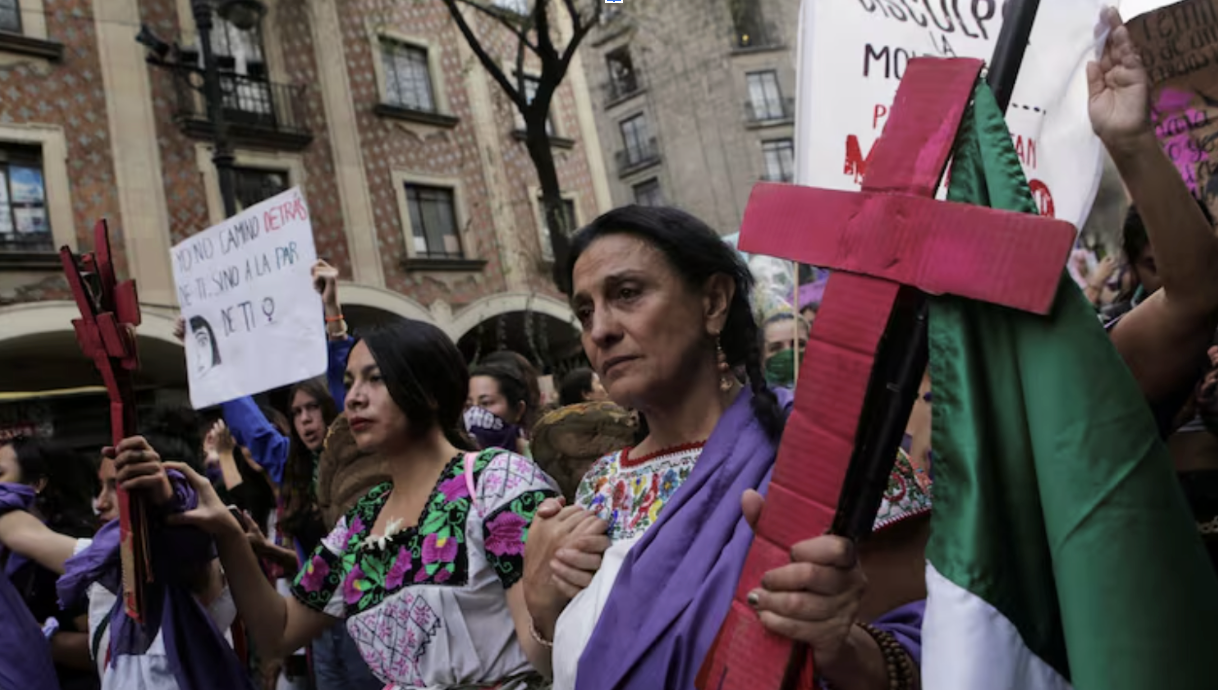
Thus, anti-femicide movements have turned to reintroducing public women as ‘hijas’ (daughters) honorably providing family income by working outside the home as an alternate tactic bringing violence against women into the public eye. Working in the public sphere for private reasons, makes violence towards these daughters realistically appear as a threat to Mexican family incomes and structures.
Their relentless fight – both in their normative reconstruction of public women’s image and in persistent protest – has raised international attention for the systematic killing of public women and the treatment of maquiladora factory workers, effectively forcing politicians running for statewide and federal office today to publicly announce how they would tackle violence against women in northern Mexico. While concerns over impunity persist, 2012 was a marked year of feminist success whereby femicide was officially added to Mexico’s penal code.
The influence of protests sparked by violence against women in Latin America has also expanded across borders. A striking example is that of the Chilean song ‘El violador en tu camino’ (A rapist in your path) which has not only been adopted by the women of Mexico but all around the world as they stand in unison against sexual violence towards women. The election of Claudia Sheinbaum as Mexico’s new president also represents a major step forward for women in Mexico and Latin America.. In a country where one woman disappears every hour and 90% of the population holds negative biases against women, having a female head of state is a huge accomplishment for gender parity. Shebeim’s political agenda includes the establishment of a ‘national care system’ to alleviate the burden of childcare, which women overwhelmingly carry alongside their work outside of the home.
Nevertheless, whether the inauguration of a female president will surpass its symbolic meaning and translate into real policies empowering women is yet to be seen. As Joan Landes iterated, violence against women does not only persist through physical violence but also through their silencing. Only is it when women’s image – constructed by the government and general public alike – is respectively equal to men that true justice and peace will be achieved.