
By: Nachiket Javali
For much of modern trade, oil was the global currency. However, with the sustainability concerns growing and the issues of climate change, it seems to have lost its shine. Today, chips have taken its place. For context, chips are the heart of almost every possible electronic device that we use today. From mobile phones to electric cars to generative artificial intelligence, chips are the soul of these products. Taiwan is at the heart of this indispensable commodity, which can’t even be seen from the naked eye. It produces more than two-thirds of the world’s semiconductors and more than 90% of the most advanced chips globally. To simplify the complex chain in the semiconductor industry – while companies like Apple and Nvidia are great at designing chips, companies like TSMC (Taiwan Semiconductor Manufacturing Company) and MediaTek mass produce these designs. This dominance is also risky as Chinese aggression towards Taiwan becomes alarmingly frequent, increasing the odds of a military invasion. Such a possibility would be a disaster for not only Taiwan but the global semiconductor supply chain, costing the global economy an estimated $10 trillion in losses according to a report by Bloomberg.
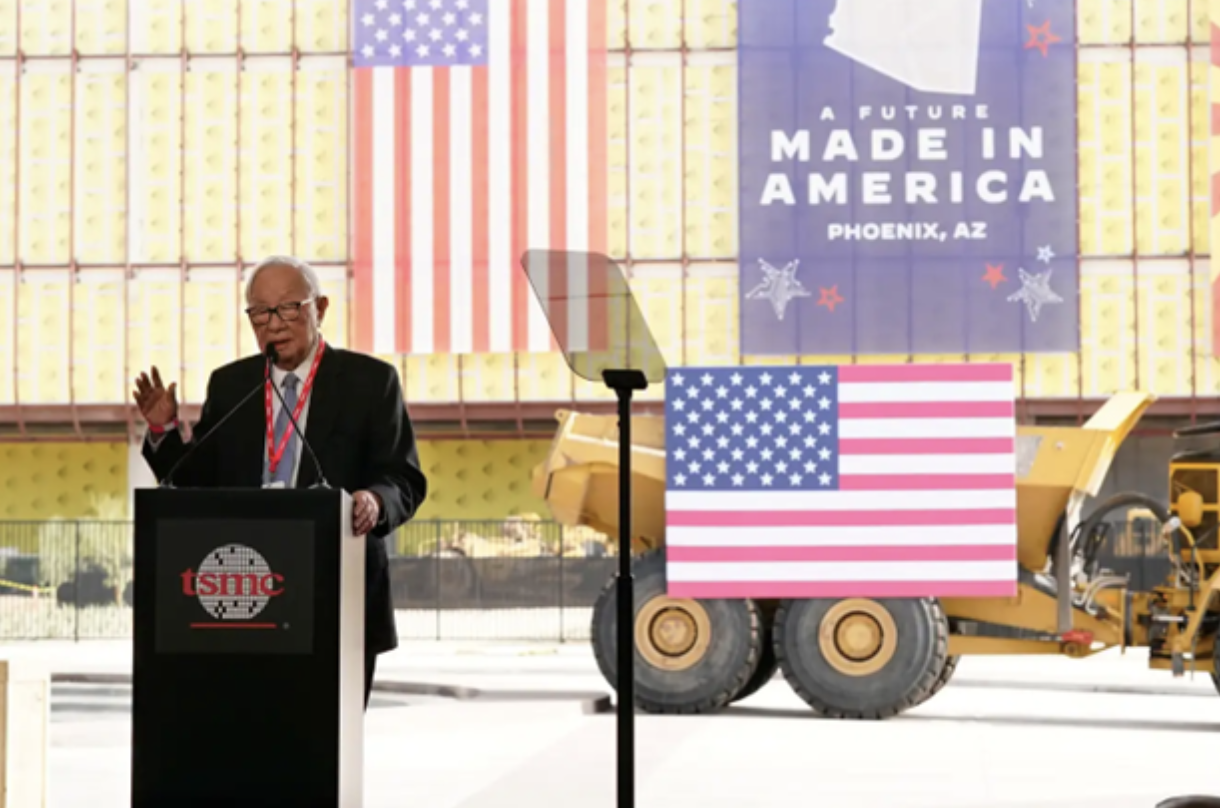
Rick Cassidy, TSMC’s US president recently announced that its Arizona plant surpassed production yields than its Taiwanese plants by four percentage points. This statistic becomes significant because this yield determines whether a semiconductor plant can recover the extensive costs that a plant incurs during production. The Taiwanese tech giant has been offshoring its production facilities to multiple new locations across the world. However, this strategy has not been approved by some in Taiwan with leaders from the Kuomintang party accusing the incumbent Democratic Progressive Party of diminishing Taiwan’s competitive advantage over other countries by establishing semiconductor plants abroad. This might not necessarily hold true – offshoring to other countries shows potential of bringing back positive returns to Taiwan. This trend is accompanied with geopolitical considerations in which Taiwan and its firms find themselves caught between the Sino-American technological rivalry.
These decisions come at a time of increasing American pressure on Chinese firms, with which TSMC and other Taiwanese semiconductor companies have historically traded. While Taiwan’s efforts to reduce its dependence on China has made headlines, Taiwan’s ambitions to shift away from the mainland are not new. Since the 1990s, under President Lee Teng-hui’s “Go South” policy, Taiwan has looked beyond China to its ASEAN partners to reduce dependencies on Chinese firms for production purposes. This included shifts to Phillipines and Indonesia, where Taiwan helped create industrial parks. However, as China’s economy surged, it became too influential for many Taiwanese firms to ignore. Particularly, during President Ma’s tenure, Cross Strait relations started becoming cozier but appeared to reach a limit with the Sunflower Movement, which opposed the Cross-Strait Service Trade Agreement. The return of the anti-CCP DPP allowed Taiwan to resume its engagement with Southeast Asia with the New Southbound Policy.
Southeast Asia is gaining continued interest from Taiwanese firms, especially after American restrictions on interactions with Chinese firms. COVID-19 and Chinese business restrictions further inflated these restrictions. Malaysia and Singapore, in particular, are witnessing notable growth in their semiconductor journeys. Malaysia is the world’s sixth largest exporter of semiconductors, focused on its production of integrated circuits in semiconductor chips. The government’s incentives towards foreign investors are part of the plan to put Malaysia on the global technology map and Taiwanese firms must capitalize on such incentives, as have other foreign firms such as Intel. ASE, a Taiwanese semiconductor packaging firm opened its fourth plant in Penang within a relatively short span of time. Singapore has emerged as a leading production site for legacy chips. Legacy chips are essential components for automobiles, aircrafts and home appliances. With its favourable investment environment, Singapore has already attracted interest from Taiwanese firms. Vanguard, a Taiwanese semiconductor firm endorsed by TSMC plans to open a plant in Singapore while United Microelectronics will commence its expansion in Singapore starting from 2026.
Taiwan’s successful people-to-people engagement through the New Southbound Policy has facilitated the education of Vietnamese engineers in Taiwan. Vietnamese students are the largest community of international students in Taiwan. Restrictive business conditions in China have benefited Vietnam’s semiconductor industry, as firms increasingly establish production sites there to offset labour shortages and a slowing Chinese economy. Apple’s partners including Pegatronn and Foxconn have agreed on building new production units in Vietnam. These trends are substantiated by numbers – in 2022, Taiwanese investments to Southeast Asia collectively those made in China. To continue these investments into ASEAN countries, Taiwan has introduced almost ten chip academies in leading Taiwanese universities since 2021. This connects with Vietnamese students going to Taiwan. The Taiwanese government has also expressed to go international with these academies. Led by the National Science and Technology Council of Taiwan, the plan aspires to attract more foreign students as Taiwanese firms expand their bases beyond the island.
In India, another growing economic power in Asia, progress with Taiwanese firms has been nascent but is expected to grow in the future. Taiwanese firms with their mass production units have created various factories across different states in India. Foxconn and Pegatron, well known Apple iPhone manufacturers have established plants in India to produce the latest iPhone models. This is significant, as these high-end iPhones were previously manufactured only in China. This directly benefits India, which is currently facing a shortage of employment opportunities. India also recognizes that it needs to start from the basics in semiconductor manufacturing given its relatively newer entry into the market. India’s abundance of young and smart labour force aids this strategy. As more countries in the semiconductor market set ambitions for more advanced levels of manufacturing, India wants to address the potential shortages towards larger nodes such as those of 40 nanometres such a trend can bring. The growing cooperation between Taiwan and India makes sense – the growing tensions with China have been well established in India, which also saw the banning of several Chinese applications citing cybersecurity concerns. India is home to approximately 25% of chip designers worldwide. For Taiwan, this presents an opportunity to retain Indian engineers at home and diversify their operations on chip design beyond America. The Indian government’s Production-Linked Incentive helps in this regard and provides useful incentives to increase domestic production. Companies like Foxconn and Wistron have benefited from this. This is similar to the Biden administration’s CHIPS and Science Act to reduce dependencies on imports.
Taiwan has taken a long-term approach in its overseas investments. The trade war imposed by America on China has had implications for the silicon industry. Most notably, the cooperation between TSMC and Huawei has drastically reduced after the Trump administration’s cyber safety accusations against Huawei. Before the restrictions came into place, TSMC produced 98% of Huawei high quality chips for smartphones. It is practical for TSMC to remain on the American side of the conflict given America’s wider reaching global clout vis-a-vis China. Huawei has ever since looked inwards and has increased demands for Chinese semiconductor giant Semiconductor Manufacturing International Corporation. This is also part of the Chinese government’s plans to accelerate its Made in China 2025 strategy which aims to domestically generate 70% of the chip demand the country has.
However, little progress has been made on this front when compared to Taiwan’s continuously expanding industry. SMIC for example is five years behind TSMC in terms of advanced chip production, according to a report published by the Information Technology and Innovation Foundation. While the trade war has successfully restricted China’s free-range access to Taiwanese expertise through trade, another challenge looms for Taiwanese firms to maintain their edge over the mainland. China has discreetly been luring Taiwanese engineers to the Chinese firms across the Strait through higher pay packages in exchange for Taiwanese semiconductor strategies. This has in part paid off, with SMIC’s CEO Liang Mong Song being a product of TSMC. He in fact left TSMC for Samsung and then later joined the Chinese firm. In terms of numbers, in 2019, at least 10% of Taiwanese semiconductor engineers were employed by firms in China. Taiwan has been compelled to address this brain drain towards China more so with the emerging American pressure. The Taiwan Chips Act has attempted to reduce the negative impact of this worrying trend by creating larger incentives for Taiwanese and foreign firms to choose Taiwan over China. Hence, when added with the trend of Taiwanese firms shifting to Southeast Asia and India, the Taiwan Chips Act is coherent keeping in mind China’s intellectual poaching.
The global expansion of Taiwanese semiconductor firms should not be seen as a loss of Taiwan’s advantage in the industry. This trend has been viewed by critics as Taiwanese semiconductor firms shifting abroad. Instead, it should be seen as Taiwanese semiconductor firms expanding abroad. As an official from InvestTaiwan said that “It’s not that Taiwan’s cake is being cut in half. The cake is getting bigger, and we’re giving some of the extra slices to America and Japan”. Taiwanese firms are indirectly fostering the development of semiconductor industries abroad, highlighting the advantages of globalisation. Expanding abroad also comes in light of Taiwan’s resource challenges as there is only so much land and water that the island of Fermosa can accommodate amidst the needs of its 24 million people. Going abroad comes with certain conditions that have been clear by Taiwan and its firms – “when TSMC promises advanced manufacturing technology overseas, it is still building that first in Taiwan”, said Wu Cheng-wen, Taiwan’s science and technology minister. They maintain that the most advanced and critical production units will always remain in Taiwan. Let’s take Apple for instance. The only major operation that makes America relevant for Apple is chip designing, that happens in the Silicon Valley. However, the chips come majorly from TSMC in Taiwan and most iPhone are mass produced and packaged in China, India and Vietnam under companies from Foxconn of Taiwan. Apple’s example is relevant because most of its operations are conducted abroad yet the company is proudly “American”. The same can apply for TSMC and can effectively address concerns of TSMC becoming ‘less Taiwanese’.
From a geopolitical perspective, going abroad comforts Taiwan’s foreign partners. As the risk of a Chinese invasion appears to become prominent, foreign investors are sceptical of keeping all their eggs in one basket. Hence, Taiwanese firms offshoring to Southeast Asia and countries like India shows Taiwan’s shift away from China and its preparedness to mitigate the shocks a Chinese invasion could have on the global semiconductor supply chain. For America, the new TSMC fab in Arizona is a win for Biden and for people who feared overdependence on Taiwan, given the American military’s contracts with Taiwanese firms for chips. This makes things more convenient for firms like Intel, Apple and Nvidia.
Taiwanese semiconductor firms must make ample use of globalisation instead of fearing of a decline in Taiwanese hegemony over the industry. Instead, a greater global footprint only shows how successful firms like TSMC and Foxconn are becoming. Their prominence will continue to give more reasons for countries that do not formally recognise Taiwan to protect it at all costs against a Chinese invasion. The ‘silicon shield’ is very much intact and if anything, shows signs of growing stronger.
The views expressed in this article are the author’s own and may not reflect the opinions of The St Andrews Economist.
Image from Ross D. Franklin, Associated Press