
By Geovanny Rodriguez
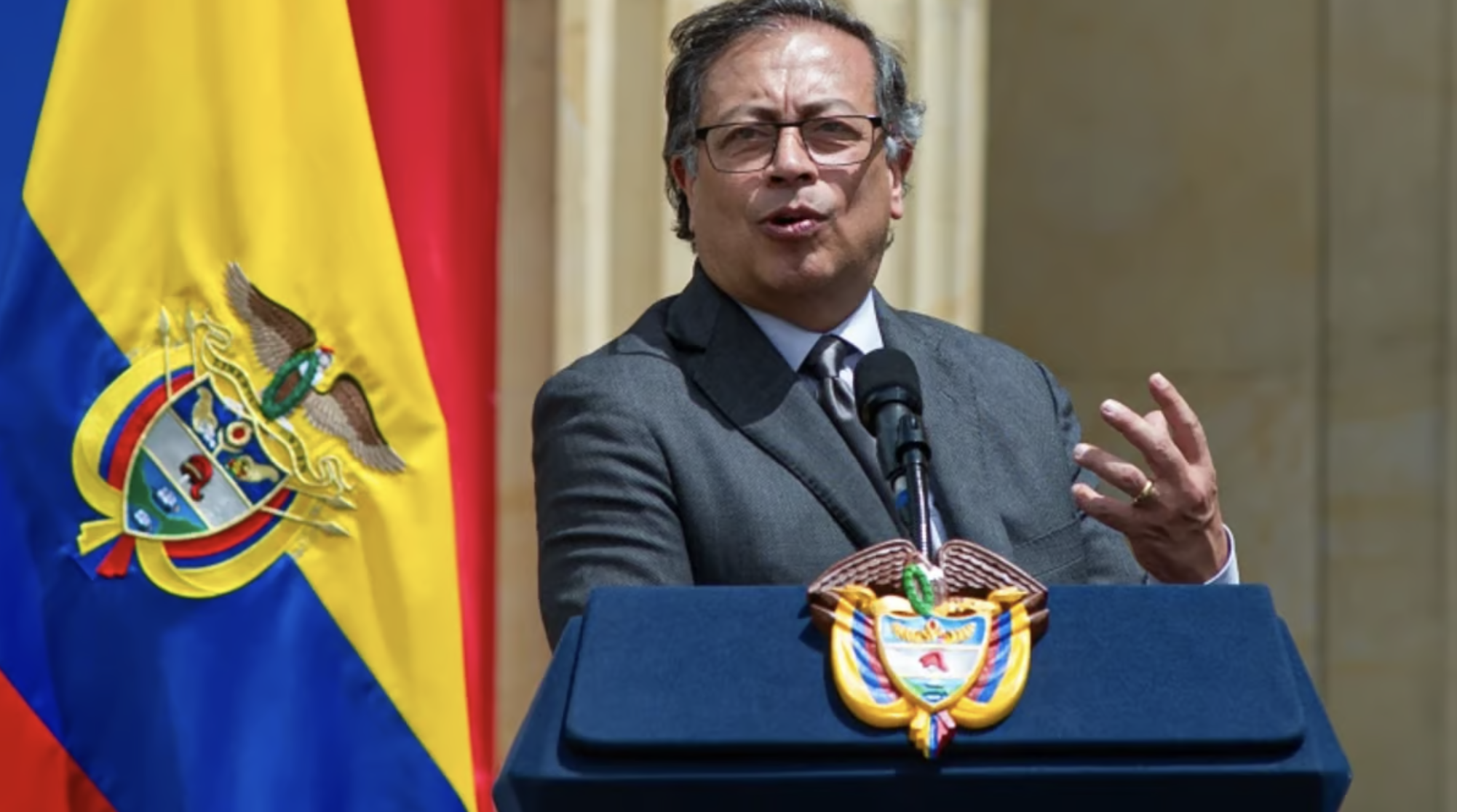
For the past 70 years, Colombia has been ruled by an unbroken chain of right-wing presidents. Many today connect the country’s slow economic growth, increasing inequality, and persistent violence to the fact that the country was controlled by the same party for so long. Results of the 2022 elections disrupted such continuity when left-wing candidate Gustavo Francisco Petro Urrego became the country’s 34th President. This shift in Colombia’s political tide is therefore a pivotal moment for the country’s recent history.
At the start of his political career, Gustavo Petro joined a Marxist revolutionary group known as the 19th of April Movement (M-19). The group was formed after an alleged fraudulent election in 1970 with the aim of ‘opening electoral democracy in Colombia’. However, the M-19’s ways of achieving their aims was through violence, producing innocent victims in the crossfire. . Thus, to this day, people associate Gustavo Petro with these attacks even though his role in the M-19 was mostly storing unauthorised firearms. Yet, even if his involvement was detached as such, people continue to view him as a criminal part of an illegal guerilla group that should never be allowed to run the country. On the other hand, his M-19 involvement even brings about positive reaction from other Colombians. A part of his successful electoral campaign was the fact that he was seen as the protector of democracy and ‘hero’ for his M-19 involvement in fighting corruption. Thus, divided opinions remain, especially once the leftist Pacto Histórico por Colombia (or, ‘Historic Pact for Colombia’) – a political and electoral coalition in Colombia encompassing centre-left to far-left political parties and social movements – chose Gustavo Petro as their candidate.
Some consider him the change Colombia needs to stop its increasing inequality gap and corruption, especially with his green initiatives focused on pushing a more environmentally friendly economy. Since his election, Petro has focused on commercial sectors – such as tourism – which were disregarded before and championed movement away from the country’s traditional dependence on oil extraction and coal mining. After two years, Gustavo Petro’s government has shown great advances in environmental issues. Deforestation went down by 36% compared to the previous years. He also played a key role as leader of the hosting nation of this year’s Biodiversity Summit (COP16) – seen as ‘the largest diplomatic event that the country has held in its recent history’. By reducing deforestation by 36% and hosting the Biodiversity Summit (COP16), Petro positions Colombia as a leader in environmental administration. This strengthens Colombia’s image on the global stage, especially within the perceptions of countries prioritising climate action, thereby paving the way for stronger diplomatic ties between them and Colombia.
At the other end of Colombia’s public opinion, others still see him as a member of the M-19. Conflicting views of the President’s morals persist insighting chaos in the Colombian political system. Petro’s past with the M-19 guerrilla group has deeply divided Colombian society, sparking frequent and sometimes violent protests. Opposition groups, particularly in Bogotá and Medellín, continue to demonstrate against his policies and background, reflecting broader concerns about crime, inequality, and corruption. These protests often disrupt public life, with anti-Petro voices expressing fears of democratic erosion. El Consejo Nacional Electoral, an autonomous and independent body seeking to maintain the sustainability of democracy in Colombia, has decided to open an investigation and charge the current president ‘for the alleged violation of the financing regime of electoral campaigns’ – an action which they deem to be the president’s attempt at a ‘golpe de estado’ or a ‘coup d’état’. Some time awaits, however, as it is very likely that the outcome of this legal battle will be defined in the near future. Investigations by the Consejo Nacional Electoral (CNE) in Colombia can vary significantly in duration, often depending on the complexity of the case, the evidence available, and the degree of cooperation from those involved. Typically, electoral investigations in Colombia may take anywhere from several months to over a year to reach a conclusion.
On 8 October, the Consejo Nacional Electoral (CNE) decided to charge Gustavo Petro with exceeding – thereby violating – the campaign spending limit by $3.709.361.342 Colombian pesos (£661,518.16). However, there remains a catch to the council’s claim: the President of Colombia cannot be charged throughout the duration of their presidency. Thus, President Petro maintains full immunity as long as he remains in that role.
This legal check on Colombia’s judiciary has thus sparked a legal debate throughout the country. Many deem it to be illegal as – technically – the Consejo Nacional Electoral (CNE) has no legal power to charge the president given his immunity. Others claim the CNE holds legal power to charge and investigate the president as the entity responsible for regulating Colombia’s election processes. Pro-CNE opinion also claims its responsibility essentially lies in upholding national democracy, exposing truths and flagging violations made by lawmakers and federal branches.Yet, what does the law say exactly? Is there a superior governmental body able to regulate this decision? The answer is yes. El Consejo de Estado (Council of the State) is Colombia’s highest authority in public administration (an entity completely independent from the Consejo Nacional Electoral (CNE)), resolving conflicts amongst individuals, state entities, or those between the two. It also advises the National Government on matters of importance when required. El Consejo Nacional has carefully reviewed the CNE’s decision to investigate the president, affirming the CNE is indeed competent to investigate potential violations of electoral limits in Gustavo Petro’s campaign. As stated, “The National Electoral Council is the authority that, by constitutional mandate, has the power to inspect, monitor, and control all electoral activities of political parties, movements, and significant groups of citizens, taking into account the technical knowledge to investigate and impose sanctions in this area.”
Responding to the supreme court (EL Consejo de Estado) decision as such, Petro formally addressed the country claiming, “Today the president’s comprehensive immunity has been broken.” However, according to Artículo 199 ‘The President of the Republic, during the period for which he is elected, or whoever is in charge of the Presidency, may not be prosecuted or tried for crimes, except by virtue of an accusation by the House of Representatives and when the Senate has declared that there is cause for the formation of a case.’ Furthermore, the Consejo Nacional Electoral (CNE) is an independent entity chosen by the congress. Thus, it is neither part of the House of Representatives or the Senate. This would mean the Consejo Nacional Electoral (CNE) is technically violating the legal right of full immunity Gustavo Petro has. Therefore, Colombian law is clearly on President Petro’s side. Yet, despite the clear codification of his immunity, why is El Consejo de Estado claiming that the Consejo Nacional Electoral (CNE) maintains the right to investigate and charge the head of state? Is the Consejo Nacional Electoral (CNE) truly trying to protect Colombian democracy or are they trying to eradicate the Colombian head of state? One insight is for certain: interpretation seems to be opposing what the law actually says.
There are two sides of this coin: on one side, as long as the CNE investigation into Petro’s campaign is not officially concluded until after his end of term, then there is no reason to believe a plan for a ‘golpe de estado’ (coup d’etat) cannot be carried out. However, it could be conversely argued the decision of the CNE to press charges risks the establishment of a precedent violating the Colombian constitution, thereby entrenching a serious threat to the country’s democracy.
The division created from this decision can not only be seen within the country but from other nations as well. The United States has positioned itself in favour of the CNE, expressing strong support for Colombian institutions as they investigate the financial records of the 2022 campaign that led to Gustavo Petro’s presidency. The House of Representatives Foreign Affairs Committee stated that Representative McCaul is “deeply concerned about the credible accusations against Gustavo Petro and his presidential campaign” and emphasised that they will “fully support Colombian institutions in their investigation of the matter.” On the other hand, Mexican president Claudia Sheinbaum showed her solidarity with the Colombian head of State saying, “even outside of the laws of Colombia, this investigation process was opened” and added that President Petro is ‘practically the only progressive president that Colombia has had.’
The controversy surrounding Gustavo Petro’s presidency and the investigation by El Consejo Nacional Electoral is a salient representation of divided opinions regarding not only the head of state, but Colombia’s entire political system. The involvement of international voices, from the United States’ support for the CNE to Mexico’s backing of Petro, further highlights the broader significance of this debate, showing it is not only about legal and constitutional limits but also Colombia’s future political trajectory on the global stage. Taken altogether and as CNE’s legal decisions develop, the outcome will not only redefine the scope of Colombian presidential power and national integrity of its institutions, but will set a global precedent for generations to come.