
By Jillian McLeod
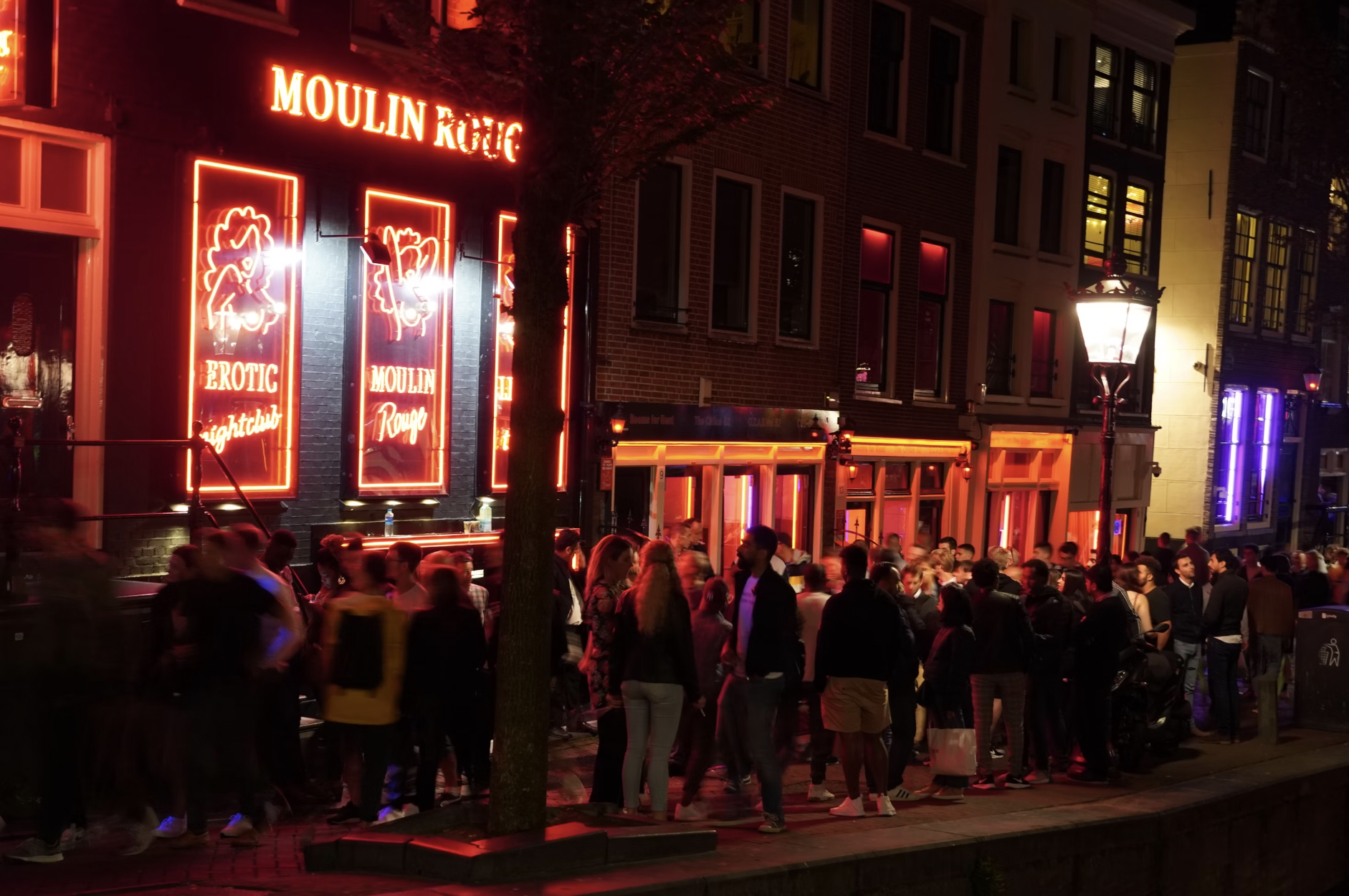
In December of 2023, a crowd of masked protesters gathered in Amsterdam’s De Wallen neighbourhood. More commonly known as the Red Light District, it bore witness to protests against the area’s potential relocation. Demonstrators carried signs that read “Support your neighbourhood sex worker,” and “If sex workers are not to blame then why are we being punished?”. Known for its window prostitution, pornographic theatres, and marijuana dispensaries, the neighbourhood’s reputation precedes it.
Since the beginning of its operation in the 15th century, De Wallen has been known globally for its indulgent recreational enterprises. When merchants and sailors moved to the nearby Canal Quarter in the 1700s, the district was soon taken over by procurers and sex workers due to the convenient proximity of De Wallen; sailors would go to the neighbourhood in search of women and alcohol. The area’s character has remained much the same.
Despite its long history in Amsterdam, prostitution was legalised in the Netherlands in 2000. The motion recognised brothels as legal businesses, so long as sex workers registered with the Chamber of Commerce as individual businesses and rented windows from licensed brothel owners. The country’s comparatively relaxed laws regarding sex work have earned Amsterdam’s Red Light District an international reputation and made it a sought-after destination for many tourists.
An estimated 200,000 people make their way to De Wallen each year. The area has become a top choice for occasions like stag trips and for groups generally looking for a pleasure-filled, often boozy experience. Alongside a significant amount of profit, tourism brings the district a set of issues. Disruptive noise, vandalism, public drunkenness, and the harassment of sex workers have lowered the neighbourhood’s esteem for visitors. Ilana Roodereck, head of the local D66 party, remarks that the district is currently “spilling over with bachelor parties and tourists dressed up in penis suits, harassing sex workers”.
As a result of this highly disruptive behavior, action has been taken that would potentially limit the ability of tourists to visit the city. The “Stay Away Campaign” specifically targets male British tourists aged 18 through 35, who come to Amsterdam and visit the Red Light District. The campaign is an effort by the Amsterdam City Council to raise awareness amongst this demographic of the impact of their actions on locals and businesses. The campaign’s targets are shown this messaging via social media and search engine results.
In July of 2023, the council also approved a ban on cruise ships, and Amsterdam has set a goal of reducing the annual number of flights into Schiphol Airport by 40,000 flights per year. Additionally, the city has increased its tourist tax to 12.5%, making it the city with the highest tourist tax in the European Union.
This action comes under the administration of Mayor Femke Halsema, who assumed office in 2018. Halsema, the first female mayor of Amsterdam, has made it a priority to improve conditions for sex workers in the Red Light District and reduce the negative impact of tourism on the historic area. She has remarked that “[a]s a woman, [she] cannot accept this kind of humiliation of women.” Halsema wants to prioritize the issue of sex worker rights while protecting the essence of De Wallen. On the topic of disruptive and dangerous tourist behavior, Halsema asserts that “It is against all women’s rights and against the idea that we want to empower sex workers”.
Halsema’s plan to improve De Wallen for its sex workers and reduce the negative impacts of tourism is the execution of a new and separate ‘Erotic Center’ in Europaboulevard, a neighborhood in the south district of Amsterdam. The center would largely replace the goings-on of the Red Light District; it would be a singular building that houses all businesses and sex work enterprises. According to Halsema, there would also be space for LGBTQ+ Amsterdammers, which would host events from feminist lectures to tantric yoga. The ground floor would consist of scenes more classicaly associated with the Red Light District, including sex shops, theaters, bars, and restaurants. In place of the district’s iconic windows, two windowed towers would stand in a style that resembles the present-day setup.
The plan is an attempt to address what city officials see as a public health and safety crisis. City councillors think that the sex trade in the Netherlands must change to combat the significant problem of sex trafficking and sex worker safety. By addressing this they also hope to resolve the greater problem of disruptive tourism brought to Amsterdam’s city center by the Red Light District.
However, the proposal is far from uncontroversial: it entails logistical challenges and begs the question of what wider cultural impact the move would have on Amsterdam. An estimated 9 out of 10 Red Light District workers oppose the move, and a survey found that a majority of Amsterdam locals are against it. In the summer of 2023, a petition was launched against the Erotic Center by workers and businesses of De Wallen, and there are numerous concerns regarding the safety and displacement of workers as a result of the relocation. Workers are concerned that their clientele would dwindle as their businesses would be in the city center. They argue that the new location may be less safe than the existing district, as it is more rurally located. Logistically, the proposed building would have limited space and would only be able to accommodate 100 of the Red Light District’s 249 prostitution windows.
Even those not affiliated with the Red Light District have voiced their concerns. The European Medicines Agency, headquartered near the proposed ‘Erotic Center’, has publicly expressed that it fears for the safety of its employees, specifically those who may work late into the night. Leaders of the new location’s district have spoken on behalf of families and residents in the area, stating that the plan will merely shift the problem of crowds and rowdiness from the city center to neighborhoods filled with families, workers, and students.
Amsterdam owes a significant portion of its international allure to the Red Light District. The city has earned itself a liberal and tolerant reputation as a result of its legal prostitution and lenient approach to soft drugs. Since gaining notoriety in the 1300s, the Red Light District has been a symbol of this tolerance in the name of recreation, in part due to the organic nature by which it arose. Creating a designated space for the district’s commerce and assigning a formality to it, could risk losing the very essence of the Red Light District that made it an attraction in the first place. On the other hand, if the Red Light district continues to go unchecked, existing problems will likely worsen. Rowdy tourism will continue to be a public nuisance, sex trafficking schemes will continue to go under the radar, and the wellbeing of sex workers will continue to be jeopardised.
As of April 2024, Amsterdam’s city council has not yet voted on whether the relocation will in fact take place. Regardless of the outcome, De Wallen and the Red Light District will be changed. No longer will the district exist as the world’s exemplification of radical recreational acceptance. The debate over the neighbourhood’s relocation brings into question how a treasured and internationally renowned destination must adapt to meet modern concerns, such as overcrowding and the safety of De Wallen’s proprietors. Ultimately, it has forced us to consider how we interact with the world’s cultural marvels.
The views expressed in this article are the author’s own, and may not reflect the opinions of The St Andrews Economist.
Image source: Unsplash