
By Oscar Braun
France has recently faced numerous political and social challenges; with the people unhappy about rising retirement ages, fuel costs, and public sector wages, is the nuclear energy dilemma just adding fuel to this fire? The growing presence of climatic change in Europe is present in the media but not always in our daily lives. We hear stories of extreme weather, earthquakes, famine, and ecocide from across the world. Amid these conditions, France’s nuclear energy is expected to face production challenges and mounting economic pressures, calling into question the future dependability of this resource.
France has one of the highest uses of nuclear as a percentage of total energy in Europe, with 68% of its energy generated among its 58 reactors nationwide.[1] Nuclear is, therefore, paramount to France’s energy supply and economy. There are two main reasons why climate change threatens the sustainability of power generation. Firstly, the water released from the plant has to be below a certain temperature. If it is too hot, the plant cannot release the water, and hence cannotproduce energy. Secondly, smaller volumes of water are to be expected in the long term. After the little glacial ice that is left melts, the river flows will slowly dry up, reducing the amount of water available for power generation.
The French court of auditors has found that there is a problem of energy sustainability within the French nuclear grid.[2] Nuclear power stations require large amounts of water, roughly 2000L per MWh, to turn the turbines in the form of steam, heated by the nuclear reactions. It is an essential part of the process; billions of litres of water are used in a single year in a plant. The point of a national grid is to ensure constant and reliable power supply. Climate change threatens this. [3][4]
The French Alps lie at the heart of this nuclear production crisis, with 14 of France’s 58 reactors lying in the Alpine and surrounding regions.[5] The main sources of water for these power plants are from glacial melt, which runs off into rivers such as the Rhône, and accumulates in the valleys, before being harvested by the nuclear plants. [6][7][8]
While melting glaciers might increase water flows in the short-term, once the glacier has melted it is gone for good. As glaciers in the Alps have been melting since the 1980s, the run-off is expected to slow in the coming years. The scale of the melt was recently highlighted by two researchers from the University of Dundee, using a technique called monoplotting to show the scale of glacial retreat on Europe’s highest peak, Mont Blanc. Dr. Kieran Baxter and Dr. Alice Watterton conducted aerial research over Mont Blanc and contrasted images from a century before to show how little glacial ice was left on the peaks and in the valleys, having lost 40% of their surface area since 1850.[9] The bleak image only gets bleaker, with studies by the World Glacier Monitoring Service at the University of Zurich expecting almost all Alpine glaciers to disappear by 2100 in a ‘business as usual’ situation.[10]

In addition to glacial melt slowing, the increased seasonal variability of climate change will increase the frequency of droughts, meaning to sustain energy production, plants will have to fall back on reservoir surpluses or divert water from other sources, both costly and environmentally damaging in itself. Warnings and forecasts issued by the French Court of Auditors thus advised French energy company, Électricité de France (EDF), not to commission six proposed new reactors without drastic water saving technology. Though these processes are not reversible, future damages might be mitigated through achieving net-zero carbon emissions in transport, agriculture, and energy production in the region.[11]
Another issue to consider is that, once the water is used in electricity generation, it cannot be released back into the natural environment if its temperature exceeds between 26 and 30 degrees Celsius (depending on the plant) according to French law.[12] However, the Autorité de Sûreté Nucléaire (ASN) temporarily eased these restrictions last summer, allowing rivers to be flooded with above-regulation, hot water.[13] This temporary measure was put in place to ‘ensure the security of the electricity network’ – however it was heavily criticised by environmentalists who have demonstrated the detrimental effects of warmer rivers on lotic ecosystems.[14] With the usual restrictions, the amount of water available for nuclear energy production is limited. Last year, the warmest on record[15] the EDF reported that they had to fully cease operations at several plants. Many people across the country have been left without reliable power during the winter months because of the slowdown in nuclear energy production.[16] France has also had to limit its export of energy to neighbouring countries such as Italy, without spare power to export to neighbours ‘starved of Russian gas.’[17] With 2023 set to become the warmest year on record once more, reliable water supplies will become scarcer and scarcer. This has pushed the French Government into further decommissioning nine nuclear reactors.[18]
However, the decommissioning coincides with the planned renationalisation of EDF aiming to ‘spearhead efforts to relaunch the county’s nuclear industry’ as well as the construction of 14 more reactors.[19] French President Emmanuel Macron stated that the coming ‘renaissance’ of the country’s nuclear industry would help drive a transition away from fossil fuels.[20] This will likely reignite debate over nuclear’s role in France’s increasingly ‘renewable’ energy future. Though no direct emissions are released, the resources required to fuel reactors are scarce and diminishing, making nuclear an unsustainable alternative to fossil fuels.
Germany’s approach starkly differs from that of France. Not only has the country completely phased out nuclear energy, but they argue government funds should not be used to extend the life of already-aging nuclear reactors.[21] It is worth noting that over half of France’s reactors are idle, with corrosion and aging putting them out of use.[22] This poses the question of whether it is futile for France to keep pumping billions of euros into EDF,[23] or if their regenerative nuclear efforts actually consider long-term sustainability and efficiency.
In the wider French economy, the ever-rising temperatures cut efficiency and productivity across the economy, not just in energy, but also with machines and labour. Workers are unable to sustain effective productivity in scorching temperatures.[24] Employers are now required by law to give employees more breaks, shorter days, and put in place better heat illness prevention mechanisms.[25] According to the World Economic Forum, levels of output across the globe could fall by as much as 4% by 2050 solely due to the effects of climate change, translating to roughly $3.4 trillion global loss in output and production. Climate change’s impact on nuclear energy production poses credible threats to France’s economic and energy security. Without proper mitigation measures, nuclear’s role in France’s energy future remains unclear.
The views expressed in this article are the author’s own and may not reflect the opinions of The St Andrews Economist.
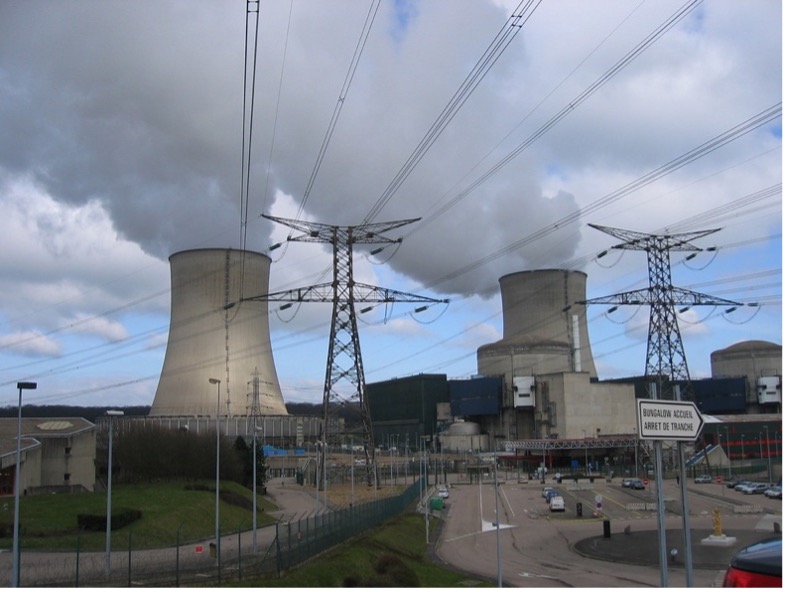
Image: Flickr, https://www.flickr.com/photos/toucanradio/1203009991
[1] https://www.eia.gov/todayinenergy/detail.php?id=55259
[2] https://balkangreenenergynews.com/climate-change-water-scarcity-jeopardizing-french-nuclear-fleet/#:~:text=Forced%20shutdowns%20of%20nuclear%20reactors,river%2C%20which%20increases%20its%20temperature
[3] https://www.iea.org/articles/france-climate-resilience-policy-indicator
[4] https://www.reuters.com/business/energy/high-river-temperatures-limit-french-nuclear-power-production-2023-07-12/
[5] https://www.world-nuclear.org/information-library/country-profiles/countries-a-f/france.aspx
[6] https://www.reuters.com/world/europe/france-heatwave-curbs-cooling-water-supply-st-alban-nuclear-plant-2023-08-23/
[7] https://www.theguardian.com/business/2022/aug/03/edf-to-reduce-nuclear-power-output-as-french-river-temperatures-rise
[8] https://revolve.media/features/the-rhone-and-the-power-of-its-waters#:~:text=The%20source%20of%20the%20813,Geneva%20at%20its%20western%20end.
[9] https://www.dundee.ac.uk/stories/new-aerial-photographs-shed-light-dark-days-mont-blanc
[10] https://www.dw.com/en/almost-all-glaciers-in-the-alps-could-disappear-by-2100-study/a-48266333
[11] https://www.theguardian.com/environment/2019/apr/09/two-thirds-glaciers-alps-alpine-doomed-climate-change-ice
[12] https://www.reuters.com/business/energy/warming-rivers-threaten-frances-already-tight-power-supply-2022-07-15/
[13] https://www.world-nuclear-news.org/Articles/Heatwave-forces-temporary-change-to-water-discharg
[14] https://www.dw.com/en/frances-nuclear-energy-option-threatens-a-warming-environment/video-62829542
[15] https://www.lemonde.fr/en/climate-change/article/2023/01/06/2022-the-hottest-year-ever-recorded-in-france_6010605_152.html#:~:text=National%20weather%20agency%20M%C3%A9t%C3%A9o%2DFrance,%2C%20fires%2C%20droughts%20and%20floods.
[16] https://www.reuters.com/business/energy/resurgent-nuclear-calms-french-winter-power-market-2023-09-06/#:~:text=Nuclear%20availability%20in%20France%20fell,reduced%20gas%20flow%20from%20Russia.
[17] https://www.reuters.com/world/france-braces-uncertain-winter-nuclear-power-shortage-looms-2022-08-30/
[18] https://www.edf.fr/en/the-edf-group/producing-a-climate-friendly-energy/nuclear-energy/edf-unique-expertise-in-nuclear-power-creation/decommissioning
[19] https://www.france24.com/en/europe/20220719-france-to-launch-buyout-of-edf-to-relaunch-the-country-s-nuclear-industry
[20] https://www.france24.com/en/live-news/20220210-macron-calls-for-14-new-reactors-in-nuclear-renaissance
[21] https://www.bnnbloomberg.ca/france-and-germany-urged-to-reach-nuclear-agreement-as-clock-ticks-down-1.1985342
[22] https://www.nytimes.com/2022/11/15/business/nuclear-power-france.html
[23] https://www.reuters.com/markets/europe/france-offers-12-euros-per-share-take-full-control-edf-2022-07-19/
[24] https://www.ilo.org/wcmsp5/groups/public/—dgreports/—dcomm/—publ/documents/publication/wcms_711919.pdf
[25] https://www.thelocal.fr/20230621/rules-for-working-in-hot-weather-in-france