
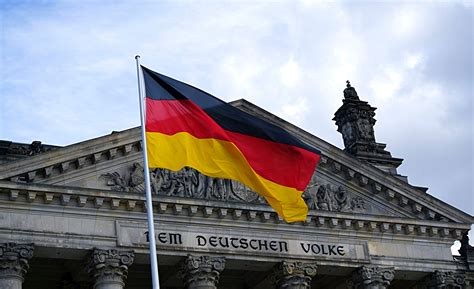
By George Capell
The German economy is a paradox. It is one of the most successful and stable economies in the world, with high levels of income, a strong manufacturing industry and a world-class education system. Its famous Mittelstände, mid-sized companies, are envied for their combination of innovation, expertise, and stability. Furthermore, at the start of the year Germany was poised to benefit from several global economic changes. The Chinese economy reopened from lockdown while energy prices fell from their peak in 2022. Both should have helped Germany’s export heavy economy.
Why, then, is economic growth proving so elusive? Recently the IMF again revised down its growth predictions from a contraction of 0.3% to 0.5% for 2023. The prediction for 2024 fell from growth of 1.3% to 0.9%. Inflation has now fallen to 4.5% but is still more than double the European Central Bank’s target. Politicians are warning of ‘deindustrialisation’ as high energy prices reduce Germany’s competitiveness. Endless bickering within the governing coalition of greens, liberals (FDP) and social democrats (SPD) is sapping energy from the debate about the serious economic reforms Germany needs. Not even the trains run on time anymore.
The reasons for this economic stagnation are plenty. Firstly, despite optimistic predictions, China’s economy has failed to grow as expected this year. China is Germany’s fourth largest export market, which means its lack of growth has a particularly large impact on the German economy. Secondly, energy prices have remained higher than their pre-pandemic level, which has hurt German industry. Germany’s large, energy-intensive manufacturing industry has struggled to maintain its competitiveness over international rivals with cheaper energy.
The energy crisis is due to both international turmoil and domestic policy blunders. For decades Germany became reliant on cheap Russian gas, so much so that the second direct gas pipeline from Russia to Germany, Nordstream 2, was only halted and then cancelled days before Russia’s invasion of Ukraine in 2022. Russia supplied 55% of Germany’s gas before the invasion but has since completely cut off direct gas imports, leaving the government searching further afield for replacement gas sources and inevitably leading to higher prices. Further compounding the energy shortage is a decision made over a decade ago by Angela Merkel to accelerate the closure all of Germany’s nuclear power stations after the Fukushima disaster. The Green Party, now in government, has long had an ideological commitment to ending nuclear power in Germany, even to the point of extending the life of coal power plants while still shutting down their nuclear alternatives. As a result, Germany has lost a clean and reliable source of energy just when it was most needed.
Third is bureaucracy. Germany has an uncanny ability to tie itself so tightly in red tape that can be suffocating. In the World Bank’s ease of doing business index, Germany ranks 22nd overall but 125th for the time taken to set up a business. The Green economy minister Robert Habeck wrote German bureaucracy has become a “barrier to investment”.
Political instability has made it harder for investors to plan for the long-term. Constant arguments weigh down the unwieldy three-party governing coalition. Much of the debate within the government this spring and summer was over a single law on how best to encourage households to install heat-pumps. The FDP has strong policy differences from the greens and SPD and now, having faced a series of poor regional election results, is providing stronger opposition from within the government.
More threats present themselves on the horizon. The far-right Alternative for Germany (AFD) has soared in the polls to second place. Given that the main parties refuse to govern alongside the AFD, stable coalitions could become even harder to build in the future. Germany’s car manufacturers risk being left behind as the world turns to electric vehicles and new Chinese car companies provide fiercer competition. An ageing population, already one of the oldest in the world, could empty the job market of vital skills while younger workers pay more to look after pensioners.
Despite the well-deserved reputation the government has for endless argument, there have been examples of the sort of scale reform Germany needs in the future. In a matter of months Germany ended its dependency on Russian gas. Olaf Scholz, the chancellor, boasted that this was the new Deutschlandtempo (Germany speed), and make no mistake, the headwinds to the Germany economy have been very strong indeed. Even the weak growth it has projected now is better than what the IMF predicted in July 2022 in the event of a complete shutoff of Russian gas.
The hurdles facing the German economy are not insurmountable. Germany was known as the ‘sick man of Europe’ 25 years ago, although in different circumstances. A set of reforms, including controversial reforms to the welfare state, turned the German economy around and made it one of the strongest growing major developed economies in Europe. The same can happen now, but Germany must step up the pace of its much-needed reform.
The views expressed in this article are the author’s own and may not reflect the opinions of The St Andrews Economist.
Image: Ingo Joseph via Pexels